Kudos Affiliates! July-August 2012

As summer heats up, so too do Affiliate accomplishments!

The Michigan State University Museum (East Lansing, Michigan) received a new grant from the Asian Cultural Council, New York City, to establish a partnership between the Michigan State University Museum and Yunnan Nationalities Museum, in Kunming, China. The $12,000 grant is aimed at creating new resources online that can be used to access Chinese folklife and ethnographic collections by scholars, museums and the public.

The National Underground Railroad Freedom Center (Cincinnati, Ohio) will receive a $1.8 million grant over three years as part of the W.K. Kellogg Foundation’s America Healing program. The three-year grant will be used for programs to increase student and public awareness and understanding about the history of racial oppression in this country.

The Long Island Museum (Stony Brook, New York) has received a grant of $286,000 from the National Endowment for the Humanities.  The highly competitive grant, awarded to only a few museums nationwide, will complete the revitalization of the Carriage Museum with two new exhibition galleries.

The GAR Foundation has awarded a $30,000 grant to the Western Reserve Historical Society (Cleveland, Ohio), for educational programming at Hale Farm & Village.

Three Affiliates received Smithsonian Community Grants program sponsored by MetLife Foundation as part of the Smithsonian Institution Traveling Exhibitions Services (SITES):

  • Institute of Texan Cultures (San Antonio, Texas) received $5,000 to fund programming that fosters self-identification and pride for dual heritage African-Native Texans. The grant will support honoraria for several scholars, craft and educational materials, and the marketing and advertising of events related to the themes of IndiVisible: African-Native American Lives in the Americas.
  • San Diego Museum of Man (San Diego, California) was awarded $3,750 to fund the honoraria of Native American skate industry professionals who will participate in a panel discussion. The grant will also support the marketing of programming related to the themes of Ramp it Up: Skateboard Culture in Native America.
  • Evergreen Aviation & Space Museum (McMinnville, Oregon) will receive $2,160 to fund the busing of economically disadvantaged and minority youth in the regional Portland area to view Black Wings: An American Dream of Flight.

A technology upgrade for Ellen Noel Art Museum (Odessa, Texas) is the result of a Permian Basin Area Foundation $5,000 grant. This technology upgrade will help support the museum’s existing website and social media sites.

American Association for State and Local History (AASLH) announced the winners of their 2012 Leadership in History Awards Winners including the following Affiliates:

  • Arizona State Museum (Tucson, Arizona) for the exhibit Many Mexicos: Vistas de la Frontera
  • Conner Prairie Interactive History Park (Fishers, Indiana) for the exhibit 1863 Civil War Journey: Raid on Indiana.
  • Montana Historical Society (Bozeman, Montana) and Montana Office of Public Instruction Indian Education for All Divisions for Best Practices in Museum Education: Museums and Schools as Co-Educators.
  • North Carolina Museum of History (Raleigh, North Carolina) for the exhibit The Story of North Carolina.
  • Ohio Historical Society (Columbus, Ohio) for the exhibit Controversy: Pieces You Don’t Normally See; for the Ohio as America Online 4th Grade Textbook; and for the Ohio History Service Corps-AmeriCorps Program.
Mission Possible: Bridging the Gap

Special thanks to our Smithsonian Affiliations summer intern Lisa Hung (University of California, Irvine) for participating in the Smithsonian’s EdLab Teacher workshops in order to share her experience with us. Here, Lisa reflects on what participating in these workshops meant to her. 

Writing 6 word stories that interpret what we see in this piece to spark our creativity, an example of the lively classroom environment EdLab promotes.

She looks up and directs her attention to the front of the room, cringing as she hears the sound of cars zoom across the board with each title. With each chunk of text, she winces at the click of the typewriter flying in from the left of the screen letter by excruciating letter. We’ve all been there; the mess of slides horribly incorporating sounds and effects on a PowerPoint presentation in attempts to bridge the technological gap between students and teachers. Kim Skerritt and Jeff Meade mentioned during the last EdLab workshop, if you don’t feel that the technological aspect of the project will add to the assignment then leave it out.

I was once that girl prefacing each blog I had written for this series, distracted and driven by routine. I’ve been in classrooms where the homework and projects were pulled directly out of the books and listened to lectures in which the material reiterates the textbook verbatim. At the end of the EdLab workshops, we all sought to create our own mission based projects and asked ourselves, as teachers; would we find joy in grading these assignments?Ultimately, what I love about the EdLab workshops is that it does an amazing job integrating our community, interests, and learning while remaining modern. EdLab conducts the workshop in a way that allows for a safe space for the educators to explore and experiment – but it doesn’t end at that, these workshops take the product of our missions and shares them with the public.

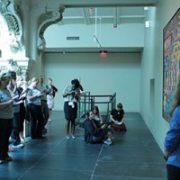
At the Smithsonian American Art Museum debriefing after a mission.

21st century technology can be attributed to the idea of mission-based learning in order to create a lively and interactive environment in the classroom. The various Smithsonian museums proved to be wonderful resources that can be utilized in our educational development. As someone who is a visual learner, being up close and personal with the paintings allowed me to better absorb information and apply it to my school and community. I have been able to liberate myself from the stereotypes many people have of Generation Y – and instead, allowed myself to embrace the blessings of this generation and use it to my advantage to create a classroom that aspires towards activism.

Looking for more information about the Smithsonian EdLab program? Click here.

Smithsonian Folklife Festival 2012: Dinosaur Dig

Special thanks to Smithsonian Affiliations intern, Neema Amadala (University of Calgary, Alberta, Canada), for this guest post.

In contrast to the University of Illinois’ cool, canopied hard-court, Lisa and I stumbled back in time to a dinosaur dig. It was a 100 degree day (or 38°C for those of us metrically inclined) and perhaps an inopportune time to be outside digging for dinosaurs. In my opinion, the best part of being a Smithsonian Affiliations intern is meeting the Affiliates: seeing the dedication they have to their projects is wonderful. For this reason, I hoped to meet a celebrity of sorts, Dr. Alan Grant of Jurassic Park fame. Not the fictional character but Dr. Jack Horner on whom Sam Neill’s character in the trilogy was the partial inspiration for and paleontological advisor to. To my chagrin, Dr. Horner had left the 2012 Smithsonian Folklife Festival but there were still dinosaurs to discover.

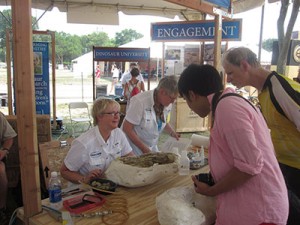
Visitors watching intently at the preparation of a specimen. Photo courtesy Smithsonian Affiliations.

On this particular dig, we were under the cover of the Museum of the Rockies (MOR), a Smithsonian Affiliate in Bozeman, Montana. I watched as children and adults wandered in, fascinated as always, by these prehistoric creatures who we discover anew every day. Festival goers could choose to conduct their own dinosaur dig, learn how casting a fossil works, watch a member of the Field Crew prepare a specimen for the lab or just learn more about Montana’s prehistoric past. Everyone on the dig was engaged and the wealth of experience and excitement MOR brought to the Folklife Festival was visible on the faces of all who passed through on the dig.

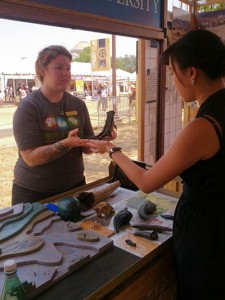
Lisa Lundgren, with MOR’s educational team, helped visitors learn about the history not just beneath the soil of Montana’s badlands but visible in its multicolored sedimentary strands. Explaining MOR’s own connection and contribution to fossil history Lisa and I were introduced to Maiasaura or ‘good mother lizard’: a giant dinosaur that unlike its contemporaries raised and fed their hatchlings. There were plenty of tactile and visual aids to keep us engaged and connected to the subject matter and like the children around me, I relished my time with the dinos.

Smithsonian Affiliations intern Lisa Hung with Lisa Lundgren from Affiliate, Museum of the Rockies. Photo courtesy Smithsonian Affiliations.

This time travelling experience showcased the expertise and knowledge that Affiliates can bring to the Smithsonian. Being an Affiliate can be about more than the loaning of artifacts, there can be an exchange of programs and expertise along with interaction with the community at large. Not only did the Festival provide exposure to visitors about Montana’s primordial past, perhaps embedding MOR as a potential stop on a future trip, but also enriched the learning experience that the Smithsonian seeks to provide to all.

Mission Possible: Creative Control

Special thanks to our Smithsonian Affiliations summer intern Neema Amadala (University of Calgary) for participating in the Smithsonian’s EdLab Teacher workshops in order to share her experience with us. Here, Neema Amadala reflects on what participating in these workshops meant to her. 

Imagine being able to interact with a painting and the museum in a completely different manner than usual. Instead of simply standing and admiring the painting, we studied and questioned its possible meaning, we created our own narrative about the painting, we didn’t let someone else interpret it for us. This type of experience can be adapted to any museum or any classroom; this approach makes field trips part of the learning experience not just an afterthought. Students unleash their creativity instead of viewing the museum as yet another excuse to leave the classroom: museums open the doors to learning and adventure.

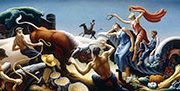
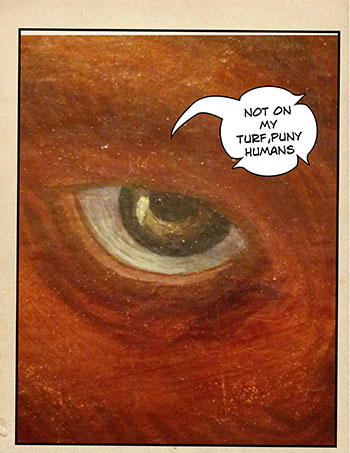
Each EdLab workshop has a theme for the week and a mission for the day but gives creative control to each individual group allowing you to choose what topics interest you and what you would like to explore further. This format can be used in any setting and made me realize how much flexibility educators have with technology. My favorite creation of the week was the comic book our group created based on a Thomas Hart Benton painting in Smithsonian’s Museum of American Art.

“Achelous and Hercules,” 1947, Thomas Hart Benton (1889-1975), tempera and oil on canvas mounted on plywood, 62 7/8 x 264 1/8 in. (159.6 x 671.0 cm.), Smithsonian American Art Museum, Gift of Allied Stores Corporation, and museum purchase through the Smithsonian Institution Collections Acquisition Program, 1985.2.

As a child, I often heard about putting myself in other people’s shoes. For a child this is a difficult thing to imagine: how do I wear the shoes of someone else? The older you get, the better you understand the meaning behind the phrase. It’s still hard to imagine until you talk to the individual, hear their struggles and the challenges they face. This workshop enabled me to understand the difficulties educators face when trying to implement new technologies in their classroom but their presence in the workshop shows their determination to find ways to continue innovating. Innovate on educators, innovate on!

For more information about the Smithsonian EdLab program, click here.

Comic the EdLab workshop participants created

Teaching in a 21st-Century Classroom: Mission Impossible?

Special thanks to our Smithsonian Affiliations summer interns Lisa Hung (University of California, Irvine) and Neema Amadala (University of Calgary) for participating in the Smithsonian’s EdLab Teacher workshops in order to share their experiences with us. This is the first of four guest posts in their “Teaching in a 21st Century Classroom” series.   

Teaching in a 21st-Century Classroom: Mission Impossible?
By: Lisa Hung

Head tilted, eyes down, arms under the desk, occasionally glancing to see if anyone else can tell what she’s up to. Sweat drips down her brow as she struggles to fix the series of ‘autocorrects’ that can’t help but get her chuckling – the sound of the footsteps draw near and her heart is racing, she looks up in the nick of time and exhales in relief. As the teacher walks away, she picks right back up where she left off. We’ve seen it before, kids on their phones getting pulled away from the classroom. Technology in the hands of a student in a formal classroom environment has become a stigma, something that many feel are taking the students away from their learning. But why turn the other way when you can face the issue, why allow technology to take away from learning when we can use it to enhance it?

Smithsonian’s EdLab Teaching in the 21st Century workshop is aimed to allow educators to explore and launch new media practices for their classrooms providing a safe environment for the educators to come together and work in teams to develop tools and skills that can be applied in their classrooms. On Monday, I was able to partake in this experience. Kim Skerritt and Jeff Meade led the workshops and assigned a warm up by having us write what we thought a 21st-century classroom looked like. Going around you could see words like “classroom without walls”, “interactive”, and “technologic”.  Upon discussion, many of the participants raised some good points and we ultimately asked – are our kids running into school with the same excitement they have running out?

Educators sharing what they felt a 21st-century classroom looks like. Photo courtesy Smithsonian EdLab.

The mission for the week was to ask how you can solve real conflict, whether that’s in or beyond the classroom. Today’s particular mission was to use objects to inspire activism, so we were split into groups and asked to explore the Smithsonian Castle and search for that piece of artwork and apply it to our weekly theme of “conflict”. Each group member took on a role, and altogether partook in a mission to interview, research and put together a final product. In the Smithsonian Castle, there are cases that represent the 19 different Smithsonian museums and each group chose a different one to represent their cause. For example, the group I was in chose Seed Catalogues in order to represent the issue of eating healthy non-processed foods.  At the end of the day, we were able to immerse ourselves in an environment in which all the participants were able to connect with each other and we left the classroom enthusiastically knowing that we will be running in the same way on Tuesday.

Interested in more information about EdLab? Contact the EdLab team at npm.mobilelearning@si.edu

At the Smithsonian Castle finding an object to inspire activism. Photo courtesy Smithsonian EdLab.

Announcing the I. Michael Heyman Smithsonian Across America Affiliations Fund

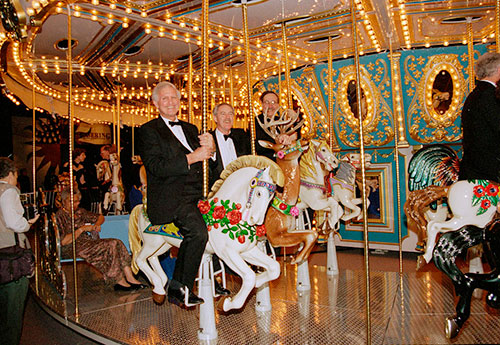
Secretary I. Michael Heyman rode the carousel at the Los Angeles Convention Center, first stop of the “America’s Smithsonian” national tour celebrating the Smithsonian’s 150th anniversary in 1996.

I. Michael Heyman, 10th Secretary of the Smithsonian Institution (1994-1999), passed away November 19, 2011.  In honor of his tenure and accomplishments friends, family, and Smithsonian officials gathered on June 14, 2012 in a special ceremony at the National Museum of American History.  Heyman was widely praised for launching a number of initiatives, Smithsonian Affiliations among them, that extended the reach of the Smithsonian well beyond the National Mall.  Smithsonian Affiliations director Harold A. Closter offered the following words of tribute, and announced the establishment of the I. Michael Heyman Smithsonian Across America Affiliations Fund:

This tribute to Mike Heyman is also the concluding program in our 16th Annual Smithsonian Affiliations National Conference – a legacy of Mike’s about which others have already spoken so eloquently.  Here with us in this auditorium are representatives of the 172 Smithsonian-affiliated museums and educational organizations, our invaluable partners in fulfilling Mike’s vision for a Smithsonian across America.  These museums reflect the breadth and diversity of the American people:  from Plymouth, Massachusetts to Honolulu, Hawaii, from Birmingham, Alabama to Bellingham, Washington, and everywhere in between.

The Saturn V Rocket at the US Space and Rocket Center (Huntsville, AL)

If you were to visit one of these Affiliate museums today, you would see national treasures from all of the Smithsonian museums, including:

  •  The cornet that Louis Armstrong learned to play in an orphanage in New Orleans, now on view at the Musical Instrument Museum in Phoenix.
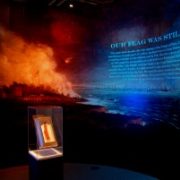
  •  An original fragment from the Star Spangled Banner at the Senator John Heinz History Center in Pittsburgh.
  •  Apollo 13, the space capsule made famous for its nail-biting return from a trip around the moon,  currently on display at the Kansas Cosmosphere in Hutchinson, Kansas.
  • And the largest object in the Smithsonian’s collection – the 363 ft. long working model of the Saturn V rocket that made the Apollo space program possible – viewed with awe by visitors at the U.S. Space and Rocket Center in Huntsville, Alabama.

These are just a few of the more than 8,000 Smithsonian objects that have traveled to every corner of this country all for one simple reason:  to make it easier for people to see the heritage of their country in their own communities. 

This was the vision that Mike Heyman so passionately believed in and this is why we are so pleased to announce the establishment of the I. Michael Heyman Smithsonian Across America Affiliations Fund.

A cornet associated with Louis Armstrong at the Musical Instrument Museum (Phoenix, AZ)

Through this fund we will honor the legacy of Secretary Heyman by extending the reach of the Smithsonian even further through the loan of artifacts, traveling exhibits, educational programs, and shared digital experiences. 

There are so many ways we can connect the Smithsonian to the American people:  to stimulate curiosity, to inspire lifelong learning, and to promote a deeper appreciation of our country’s history and the many people who have strived and sacrificed to ensure our freedom and prosperity. 

Mike Heyman saw both sides of the Smithsonian coin.  On one side, about 30 million people visit the Smithsonian each year, a measure in which we take great pride.  But on the other side, nearly 300 million Americans are unable to come to the Smithsonian annually, and some of them might only come once in a lifetime. 

These are also the people that Mike Heyman wanted to reach, the people we will reach through the I. Michael Heyman Smithsonian Across America Affiliations Fund.  And this is how we will perpetuate the memory and the name of the individual who did so much to transform the Smithsonian at a pivotal moment in its history. 

We are grateful for your interest and support, and will look forward to working with all of you to establish this tribute to our dear friend and colleague. 

Those interested in contributing or learning more about this opportunity to honor the life and accomplishments of I. Michael Heyman are invited to contact the Smithsonian at: 

A fragment of the Star Spangled Banner at the Senator John Heinz History Center (Pittsburgh, PA)

I. Michael Heyman Smithsonian Across America Affiliations Fund
c/o Smithsonian Affiliations
MRC 942, PO Box 37012
Washington, DC 20013-7012

Phone:  202.633.5300
Email:    affiliations.si.edu