National Youth Summit: Dust Bowl

The Smithsonian and the National Endowment for the Humanities examine the legacy of the Dust Bowl era through current issues of drought, agricultural sustainability and global food security during a live, interactive discussion with experts. The program will be webcast from the museum to Youth Town Halls at locations across the nation Oct. 17 at 1 p.m. EDT.

In the 1930s, severe drought and extensive farming caused widespread agricultural damage, crop failure and human misery across the Great Plains. Called the “Dust Bowl” because of the immense dust storms created as the dry soil blew away in large, dark clouds, it is considered one of the worst ecological disasters in American history. Millions of acres of farmland were damaged and hundreds of thousands of people were forced to leave their homes. Many migrated to California and other western states where the economic conditions during the Great Depression were often no better than those they had left.

The Oct. 17 discussion in Washington, D.C., taking place in the Warner Bros. Theater at the Smithsonian’s National Museum of American History, will be joined by audiences at nine Smithsonian Affiliate museums and the National Steinbeck Center, which will also host regional Youth Town Halls. Participants at the regional Town Hall sites will prerecord questions on video to be played during the live National Youth Summit webcast. The Youth Town Halls will take place at:

The live webcast is available to educators and students through free registration at americanhistory.si.edu/nys. 

The National Youth Summit brings middle and high school students together with scholars, teachers, policy experts, witnesses to history and activists in a national conversation about important events in America’s past that have relevance to the nation’s present and future. The program is an ongoing collaboration between the National Museum of American History, the National Endowment for the Humanities, PBS and museums across the United States in the Smithsonian Affiliations network.

The summit will include segments from award-winning documentary filmmaker Ken Burns’ forthcoming film The Dust Bowl and a panel discussion, moderated by Huffington Post science editor Cara Santa Maria, and featuring: Ken Burns, Dust Bowl survivor Cal Crabill, U.S. Department of Agriculture ecologist Debra Peters, fifth-generation farmer Roy Bardole from Rippey, Iowa, and farmer and founder of Anson Mills, Glenn Roberts. U.S. Secretary of Agriculture Tom Vilsack will welcome the audience through a video statement. Panelists will take questions from students participating in the summit, and offer their own perspectives on what history can teach people about their relationship with the environment.

Programming for the National Youth Summit on the Dust Bowl is produced by the National Museum of American History and the National Endowment for the Humanities in partnership with Smithsonian Affiliations and PBS/WETA.

Smithsonian Affiliations collaborates with museums and educational organizations to share the Smithsonian with people in their own communities and create lasting experiences that broaden perspectives on science, history, world cultures and the arts. More information about Smithsonian Affiliations is available here.

The National Endowment for the Humanities is an independent federal agency created in 1965.  It is one of the largest funders of humanities programs in the United States. NEH grants typically go to cultural institutions, such as museums, archives, libraries, colleges, universities, public television and radio stations, and to individual scholars. For more information on the NEH, visit https://www.neh.gov/.

The National Museum of American History collects, preserves and displays American heritage in the areas of social, political, cultural, scientific and military history. To learn more about the museum, check americanhistory.si.edu. For Smithsonian information, the public may call (202) 633-1000.
SI-Q: What tells stories of life and death but never speaks a word? #SeriouslyAmazing

By Cara Seitchek, Writer, Smithsonian Affiliations. Part of our Seriously Amazing Affiliates blog series.

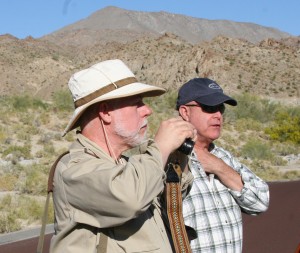
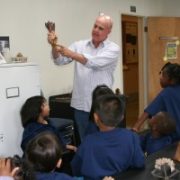
Russell in the field with other Citizen Scientists. Photo courtesy Danielle Leland, riverside Metropolitan Museum.

“The only single unambiguous personal record of a scientist’s research is in his field book. They can contain stories of life and death that are fascinating,” said Rusty Russell, collections manager for the U.S. National Herbarium located in the National Museum of Natural History (NMNH).

On most days, Russell is surrounded by the quiet of the Herbarium and many shelves of dried plant specimens that record centuries of expeditions around the world. In his 30+ years working for the Department of Botany, Russell has brought order and innovation to these collections – creating a bar coding system, scanning specimens into a digital library, and placing botanists’ field books online.

For eight years, Russell has been bringing his encyclopedic knowledge of plants to Smithsonian Affiliate Riverside Metropolitan Museum (RMM), creating citizen science programs that take residents into the field and help them build their own collections of indigenous plants.

“Our citizen science weeks came about in an interesting way,” said James Bryant, RMM curator and a former student of Russell’s. “I discovered some specimens in our collections that had been collected by Edmund Jaeger, who also collected for the Smithsonian. When I contacted Rusty, he pulled the NMNH specimens and we started talking about the history of the mountains in this area and how they had been affected by climate change.”

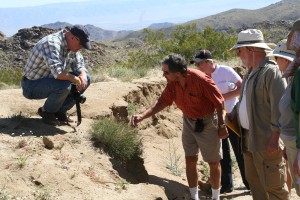
Russell works in the field to bring Citizen Science Week to Riverside, California. Photo courtesy Danielle Leland, Riverside Metropolitan Museum.

The challenge of exploring an area that had not been studied for 70 years intrigued both men and soon, Russell was leading a team to explore the Santa Rosa – San Jacinto Mountains slopes that Jaeger had studied. This initial field trip grew into a larger program that brings California residents into the field to make their own observations and field notes. Every spring, Russell travels back to Riverside to lead a week-long citizen science program.

In one program, the week focused on wildflowers and how floral areas transition to the nearby desert. Activities included short hikes, making pressed flowers, workshops, and lectures, all designed to increase citizen awareness and appreciation of the region’s environments.

Russell’s visits to Riverside have increased the community’s awareness of the importance of their environment. The City of Riverside is now planning a city-wide citizen science project for its open spaces and was just awarded a California State Parks grant for $780,000 to build a nature center that will be the base for even more citizen science projects. “Rusty’s prominence in the field and our relationship with the Smithsonian contributed to Riverside receiving the grant,” said Bryant. “Citizen Science Week has been a catalyst for many spinoffs.”

These spinoffs include an invitation for Bryant and Russell to speak at a conference at the California Academy of Sciences, which is exploring how to create a state-wide citizen science program. The University of California, Riverside provides scholars and experts to serve as the research arm of the citizen science efforts, while nearby Redlands company ESRI has worked with RMM to create a geographic information system software for digital field notes, which is used by a wide network of volunteers who document plant changes and responses to climate change. “Our citizen scientists use this to collect and provide this data to scientists like Rusty,” said Bryant. “It’s sparked a revival of interest in this area.”

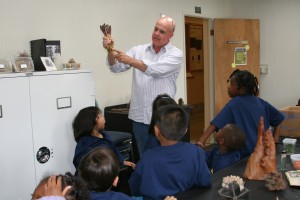
Russell in the classroom in Riverside, California. Photo courtesy Danielle Leland, Riverside Metropolitan Museum.

Both Russell and Bryant agree that RMM’s active relationship with the Smithsonian has benefits for both institutions. “Riverside is also helping the Smithsonian,” said Bryant. “We have helped the Smithsonian establish a presence in our community, and as a result we are providing the Institution new research data, programs and new members.”

The nice thing about this project is that it brings smaller places together with the Smithsonian,” said Russell. “Many people may not have the opportunity to go to Washington, D.C., but through this kind of outreach, the Smithsonian plays an ongoing role in this community.”

affiliations staff on the road

Affiliations staff will be attending regional museum association conferences all over the country this fall.  Will we see you there?  Let us know!

*Save the date* – we’ll be hosting another Affiliate reception at the AAM Annual Meeting this year in Baltimore, May 2013.  Stay tuned for details!


Western Museums Association, Palm Springs, CA, October 21-24, 2012
Look for External Affairs Coordinator Elizabeth Bugbee .


Southeastern Museums Association, Williamsburg, VA, November 7-9, 2012
National Outreach Managers Alma Douglas, Aaron Glavas, and Caroline Mah will be in attendance, and leading a session on ‘Smithsonian as Partners in your Community’ on Wednesday, November 7. 


New England Museum Association, Burlington, VT, November 7-9, 2012
National Outreach Manager Jennifer Brundage  will be there leading sessions on ‘Theater and Dance: Tools for Community Engagement and Collaboration,’ on Wednesday, November 7; and ‘Executive Transitions – Learning from Each Other,’ on Thursday, November 8.

We look forward to seeing Affiliates this fall!

Kudos Affiliates! September 2012

As summer heats up, so too do Affiliate accomplishments!

The Michigan State University Museum (East Lansing, Michigan) received a new grant from the Asian Cultural Council, New York City, to establish a partnership between the Michigan State University Museum and Yunnan Nationalities Museum, in Kunming, China. The $12,000 grant is aimed at creating new resources online that can be used to access Chinese folklife and ethnographic collections by scholars, museums and the public.

The National Underground Railroad Freedom Center (Cincinnati, Ohio) will receive a $1.8 million grant over three years as part of the W.K. Kellogg Foundation’s America Healing program. The three-year grant will be used for programs to increase student and public awareness and understanding about the history of racial oppression in this country.

The GAR Foundation has awarded a $30,000 grant to the Western Reserve Historical Society (Cleveland, Ohio), for educational programming at Hale Farm & Village.

Three Affiliates received Smithsonian Community Grants program sponsored by MetLife Foundation as part of the Smithsonian Institution Traveling Exhibitions Services (SITES):

  • Institute of Texan Cultures (San Antonio, Texas) received $5,000 to fund programming that fosters self-identification and pride for dual heritage African-Native Texans. The grant will support honoraria for several scholars, craft and educational materials, and the marketing and advertising of events related to the themes of IndiVisible: African-Native American Lives in the Americas.
  • San Diego Museum of Man (San Diego, California) was awarded $3,750 to fund the honoraria of Native American skate industry professionals who will participate in a panel discussion. The grant will also support the marketing of programming related to the themes of Ramp it Up: Skateboard Culture in Native America.
  • Evergreen Aviation & Space Museum (McMinnville, Oregon) will receive $2,160 to fund the busing of economically disadvantaged and minority youth in the regional Portland area to view Black Wings: An American Dream of Flight.

A technology upgrade for Ellen Noel Art Museum (Odessa, Texas) is the result of a Permian Basin Area Foundation $5,000 grant. This technology upgrade will help support the museum’s existing website and social media sites.

American Association for State and Local History (AASLH) announced the winners of their 2012 Leadership in History Awards Winners including the following Affiliates:

  • Arizona State Museum (Tucson, Arizona) for the exhibit Many Mexicos: Vistas de la Frontera
  • Conner Prairie Interactive History Park (Fishers, Indiana) for the exhibit 1863 Civil War Journey: Raid on Indiana.
  • Montana Historical Society (Bozeman, Montana) and Montana Office of Public Instruction Indian Education for All Divisions for Best Practices in Museum Education: Museums and Schools as Co-Educators.
  • North Carolina Museum of History (Raleigh, North Carolina) for the exhibit The Story of North Carolina.
  • Ohio Historical Society (Columbus, Ohio) for the exhibit Controversy: Pieces You Don’t Normally See; for the Ohio as America Online 4th Grade Textbook; and for the Ohio History Service Corps-AmeriCorps Program.

On the horizon at SITES

Our friends at the Smithsonian Institution Traveling Exhibition Service (SITES) are working on some great upcoming exhibitions, debuting in 2014.  Book early!

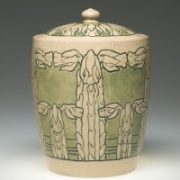
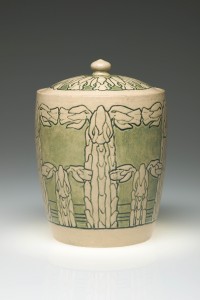
The Newcomb Pottery enterprise ‘played a significant role in promoting art, education, and employment for the betterment of women,’ particularly Southern women.

Women, Art, and Social Change: The Newcomb Pottery Enterprise, organized by the Newcomb Art Gallery and SITES, brings together more than 175 objects representing 45 years of uncommon achievement in American arts and crafts from 1895-1940.

For the first time in 30 years, Americans will experience a major exhibition of Newcomb treasures from the gallery at Tulane University and other prominent collections.  The exhibit will feature recent acquisitions and dazzling examples of the iconic pottery as well as lesser known textiles, metalwork, jewelry, bookbinding and historical artifacts.Decorative yet useful, iconic yet varied, richly imagined and precisely crafted by hand–the objects alone tell an eloquent story. Women, Art, and Social Change: The Newcomb Pottery Enterprise offers new insights into the Newcomb community–the philosophy, the friendships, the craftsmanship, and the extraordinary women who made an enduring mark on American art and industry. 

Exhibition at a glance:
– Approximately 150 objects including pottery, metalwork, jewelry and textiles
– Approximately 4,000 – 4,500 square feet
– $65,000, per 12-week booking period
– Tour begins: Fall 2014
– Contact: Minnie Russell, russellm@si.edu, 202.633.3160.

SITES is pleased to announce plans for the national tour of Aesop’s Fables by Jacob Lawrence, an exhibition featuring 23 illustrations of these classic moral stories by this renowned American artist.  In 1969 Lawrence created this series of lively ink drawings to illustrate and interpret Aesop’s Fables for a contemporary audience.  Fables such as “The Tortoise and The Hare”, “The Ant and The Grasshopper”, and “The Wolf in Sheep’s Clothing” are known and loved world-wide and are still often used to entertain and educate young children. 

Exhibition at a glance:
– Featuring 23 large-format pigment prints on watercolor paper, illustrated fable panels
– Requires about 200 running feet
– Tour begins: 2014 
– Contact:  Ed Liskey, liskeye@si.edu, 202.633.3142.


Nature’s Best Photography:  Windland Smith Rice International Awards 
showcases the wonders of the natural world in all of its breathtaking forms and environments.  From endangered species, animals that live in the ocean and in the air and the smallest animals to images of people in nature, the power of nature, plant life and amazing landscapes, the exhibition features an award-winning survey of nature photography.  This collection of 48 large-format prints combines art with adventure to take you on a photographic journey into the wild. 

   Exhibition at a glance:
   – Featuring 48 large-format prints
   – Requires about 250 running feet
   – Tour begins: early 2014
   – Contact:  Amanda Cane, canea@si.edu, 202.633.3109.


invention invention everywhere!

Since Smithsonian Affiliations started collaborating with the Lemelson Center for the Study of Invention and Innovation at the National Museum of American History, we’ve learned a lot about Places of Invention.  (See this blog to learn more about our collaboration.) 

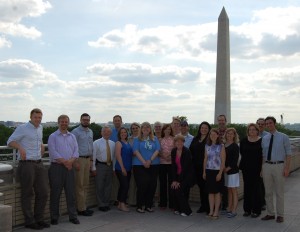
Affiliate staff and their community partners, on the roof of the National Museum of American History during the kickoff workshop for Places of Invention

Affiliates have joined the action too.  On June 15, Affiliate staff and their community partners joined a day-long workshop to kickoff their individual research projects around their own communities and what makes them so innovative.  (Read more about the kickoff workshop on the Lemelson Center’s blog, Bright Ideas.)

Now, we are all much more attuned to what makes a place of invention – be it exceptional natural resources, the right mixture of people and skills, or an inspiring location… or something else.  Invention was readily on view during a recent trip to western Massachusetts, and we suspect, can be documented in many other communities as well.

Join the quest for invention and share your stories with us!