Youth Capture the Colorful Cosmos Program

Teach kids astronomy by controlling real telescopes over the internet, and create images like these!

Youth Capture the Colorful Cosmos Program is a special opportunity for 25 Affiliates from the Smithsonian Astrophysical Observatory (SAO) and Smithsonian Affiliations. Qualified Affiliates that successfully complete the online professional development program to facilitate the use of the MicroObservatory online telescope system will be awarded $1500 for implementation of Youth Capture the Colorful Cosmos Program. Funding has been provided by the Smithsonian Youth Access Grant Fund.   

  • Are you an Affiliate educator interested in sharing the art and science of astrophotography with youth in your community?   
  • Does your organization have an informal education program, partnerships with area community centers or middle schools and interest in providing enrichment activities for students based on STEM? 
  • Can your museum or organization implement a workshop for middle school students, underserved by science and technology educational programs, ages 12 – 18   (minimum of 10 or more students) and facilitate an 8 – 20 hour program? 
  • Would you like to learn how to organize and promote an exhibition of youth-created astronomy photographs? 

For more information on the program, join us for a Teleconference to discuss implementing Youth Capture the Colorful Cosmos Program on Tuesday, March 6, 2012, at 4:00 p.m. Eastern Standard Time. 

Dial In:  1-877-860-3058
Participant Pass code:  607773
Call in and learn about participating in this program before registration goes live.  

Talk to SAO astronomy educators Mary Dussault and Erin Braswell. Smithsonian Affiliations representatives Christina Di Meglio Lopez and Caroline Mah will also be available to answer questions.

Follow the MicroObservatory’s Twitter feed; Facebook page; and Flickr photostream.
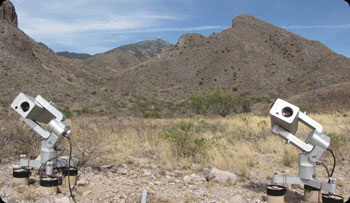
Telescopes "Ben" and "Cecilia" at the Whipple Observatory in Amado, AZ. Along with "Annie," located on the roof at SAO, they are three in a network of telescopes, controllable over the internet, helping students learn more about astronomy. Photo Credit: Dan Brocious/SAO.

do you live in a place of invention?


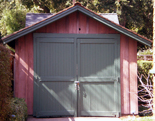
The iconic Hewlett-Packard garage in 2009. Courtesy of BrokenSphere/ Wikimedia Commons.

Company labs.  Governmental research centers.  Universities.  These places are where many of us think inventions happen.  But how about garages, coffee shops, parks, or other community gathering spots?!  Invention can happen in all kinds of places.  This idea forms the foundation of the Lemelson Center’s exhibition in development, Places of Invention.  It’s about communities “where people, resources, and spaces have come together to spark inventiveness.”  Does that describe your environment?  If so, consider contributing your story to the Places of Invention exhibition website.

The Lemelson Center team has assembled case studies of historic and contemporary invention hubs – Hartford, CT in the late 1800s; Hollywood, CA in the 1930s-40; Minneapolis/St. Paul, MN in the 1950s-60s; Silicon Valley, CA and the Bronx, NY in the 1970s-80s; and Fort Collins, CO today.  Over the course of the next year, the exhibition team will work closely with six Affiliates to create community documentation projects of their places of invention to be featured in the exhibition.  Affiliate partners in this project include: the Heinz History Center (Pittsburgh, PA); American Museum of Science and Energy (Oakridge, TN); Museum of History and Industry (Seattle, WA); Lakeview Museum (Peoria, IL); American Textile History Museum (Lowell, MA); and The Works: Ohio Center for History, Art and Technology (Newark, OH).

But we know there are many more stories to be told.  Take the Lemelson Center’s survey or email them at lemcen@si.edu to describe your place of invention and join the conversation!

kudos! affiliates for february 2012

The Center for Jewish History (New York, New York), announced a $2.5 million gift from The David Berg Foundation to establish The David Berg Rare Book Room.  This contribution will enable the Center and its partners to realize their longstanding goal of creating a public space that showcases and preserves some of the most important works in Jewish history.

Arab American National Museum (Dearborn, Michigan) will receive $15,000 from The Michigan Humanities Council to develop and implement “Setting Our Table,” an interpretive exhibit focusing on Arab American food ways concepts and customs as a gateway to culture. The exhibit will explore the culinary diversity of the Arab world and how foods have changed as Arab immigrants acclimated to life in Michigan and America. The project is funded through the Council’s Major Grants Program “Michigan People, Michigan Places; Our Stories, Our Lives.” The program emphasizes collaboration among cultural, educational and community-based organizations to provide public humanities projects.

water matters


Join the Smithsonian Center for Education and Museum Studies for FREE online webinars around the theme of water.  These are great events to share with  your local teachers, educators and students. 

In February, March, and May, the Smithsonian will look at water, the most essential of subjects, from many points of view, from marine biology to American history. Explore both water quality (how we can ensure that water is safe for ourselves and for the environment) and water quantity (how we can manage crises of too much water and not enough water).

We invite you to take part with your K-12 class, or on your own as professional development. The Shout program addresses curriculum standards for ecological, social, and economic systems; human impact on the environment; and civic responsibility.

Free registration is now open. 

Here’s some details to “wet”  your appetite for learning!

Teacher Preview Session
January 19, 2012, 3pm EST 

Get ready to make the most of the Shout: “Water Matters” program by signing up now for the teacher preview session on Thursday, January 19, 2012 at 3 pm ET. If you cannot participate live, a recording will be made available following the live event for your enjoyment at any time.   You’ll learn about Smithsonian classroom resources, interact with other teachers who are also incorporating the SHOUT program into their curriculum, and discover how to stay connected through various social media sites. This online preview will allow you to plan ahead for the upcoming conference sessions and will be a forum for discussion of incorporating global environmental issues into the classroom.

Water Questions: When We Want to Learn More
February 7-8, 2012

For the full program for February 7-8, visit: https://www.smithsonianconference.org/shout/program-2012/

Topics to be Covered include:

Planet Water
What kinds of human interventions can help the health of marine life?

It’s Not Easy Being Amphibian: The Importance of Water
How does water quality and quantity relate to conserving amphibians in captivity and the wild?

Listening to the Water Nations
How do Indigenous peoples perceive and respond to water issues?

A Look Back at Music as an Environmental Advocacy Approach
How can music build awareness of environmental issues?

Looking at Global Water Resources from Space
What can orbiting satellites tell us about Earth’s greatest resource?

The Nitrogen Problem: Causes and Remedies
How can our actions affect coastal waters and the cycle of an essential element?

Sink or Float: Water and Design Solutions
How does design solve problems of individuals and communities around the world in sustainable ways?


Stay Connected:
Twitter: twitter.com/shoutlearning
Facebook: facebook.com/shoutlearning

This event is part of Shout, a collaboration between the Smithsonian Institution, Microsoft Partners in Learning, and TakingITGlobal. More at www.shoutlearning.org.
SEE YOU THERE!

Mastodon Menagerie

Special thanks for this guest post to James “Zach” Zacharias, Senior Curator of Education and Curator of History at The Museum of Arts and Sciences, a Smithsonian Affiliate in Daytona Beach, Florida. 

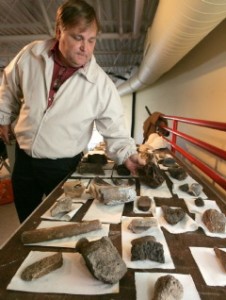
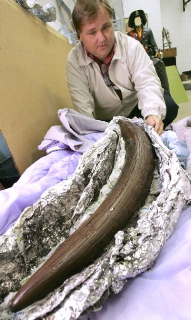
James "Zach" Zacharias, Senior Curator of Education at the Museum of Arts and Sciences, with one of the tusks from an adult mastodon. Photo courtesy of The Museum of Arts and Sciences.

The Monday morning before Thanksgiving 2011 seemed like any other day at the Museum of Arts & Sciences (MOAS) until the City of Daytona Beach emailed me a picture of what appeared to be a large lower jawbone. The City had been excavating a drainage pond two miles north of the Museum and workers found massive and mysterious bones. Upon closer inspection of the image, it became clear to me that I was looking at the lower mandible and teeth of an American Mastodon. 

The City promptly postponed construction so MOAS could dispatch personnel to the site. Although I was in a shirt and tie, I jumped into the mud- and muck-filled pit for a closer look! Within five minutes, I located a partially exposed tusk protruding from the pond’s north wall. As I investigated the layers of earth, I knew right there and then this was the tusk of an Ice Age mammoth or mastodon. It dawned on me this was turning into an incredible prehistoric discovery for our area. With hopes of unearthing the full skeleton, we set to work. 

An army of Museum staff and associates quickly converged on the site to help in the excavation effort. With painstaking care and effort, two delicate partial tusks were removed. These precious pieces of the Pleistocene were each placed in a “plaster jacket” (a protective covering used by paleontologists to move fossil specimens from the field) and moved to their secure home at the Museum. 

Assorted museum staff and volunteers at the construction site at the bottom of the drainage pond being excavated. Photo courtesy of The Museum of Arts and Sciences.

The rest of the excavation soon turned into a salvage operation. Unbeknownst to the workers, a portion of the skeleton (other than tusks) which was interspersed amongst the rocks and stones had been routinely put through a giant rock screener. This broke up some parts of the skeletal remains. As MOAS representatives sifted through the debris piles, a plethora of broken vertebra, ribs, limbs and skull bones were found. Currently, MOAS is cleaning, sorting and accessioning the fossils. A portion of the femur is currently being prepared for carbon dating by the Smithsonian National Museum of Natural History.  

A construction worker found this lower mandible of the American Mastodon. Photo courtesy of The Museum of Arts and Sciences.

This is the second significant paleontological find for the Museum of Arts & Sciences – the first being the 1975 discovery of the remains of 13 giant ground sloths in a barrow pit near Nova and Reed Canal roads. MOAS proudly displays the most complete and best preserved giant ground sloth skeleton in the world.  

Florida’s peninsula has submerged and re-emerged numerous times as the earth has passed through ice ages and warming trends. The paleontology of Florida demonstrates there were no dinosaurs here (the state was underwater during the Mesozoic Era) and this is reflected in the abundant marine fossils found in Central Florida. The animal fossils found here belong to “mega-fauna” mammals such as the giant ground sloth, mastodons and mammoths, saber cats, dire wolfs, paleo llamas, and the glyptodon. They roamed our landscape from 130,000 to 10,000 years ago.  

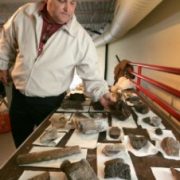
James "Zach" Zacharias with the assorted bone fragments from the mastodon. Photo courtesy of The Museum of Arts and Sciences.

The discovery of the Daytona Beach American Mastodon is thrilling and exciting for the Museum, the City and our community. MOAS is looking forward to adding the fossils to an exhibit for all to see –encouraging inspiration, curiosity, and the love of knowledge.

coming up in affiliateland – december 2011 and january 2012

a busy ending to 2011… and full steam ahead into 2012!  

TEXAS:
The
Frontiers of Flight Museum hosts the the National Air and Space Museum’s At the Controls in Dallas, 12/1.

GEORGIA:
The
Southern Museum of Civil War & Locomotive History celebrated its 10th anniversary as a Smithsonian Affiliate in Kennesaw, 12/3.

COLORADO:
The
Littleton Museum hosts SITES’ 125 Years of Lasting Light: Grand Canyon Photography in Littleton, 12/8.

TENNESSEE:
The
American Museum of Science and Energy hosts SITES’ Earth From Space in Oak Ridge, 12/16.

FLORIDA:
The
Mennello Museum of Art will host SITES’ William H. Johnson: An American Modern in Orlando, 1/6.

MISSISSIPPI:
The Smithsonian Early Enrichment Center will present a professional development workshop at the
Ohr-O’Keefe Museum of Art in Biloxi, 1/12.

FLORIDA:
The
Orange County Regional History Center will host SITES’ Beyond Baseball: Roberto Clemente in Orlando, 1/21.

WASHINGTON, D.C.:
Plimoth Plantation (Plymouth, MA), Birmingham Civil Rights Institute (Birmingham, AL), National Museum of American Jewish History (Philadelphia, PA), Arab American National Museum (Dearborn, MI), Japanese American National Museum (Los Angeles, CA), Senator John Heinz History Center (Pittsburgh, PA), Institute of Texan Cultures (San Antonio, TX), and the Western Reserve Historical Society (Cleveland, OH) will participate in a two day meeting to brainstorm ways in which the institutions could work together to foster civic engagement on immigration/migration issues, 1/25-1/26.

WASHINGTON, D.C.:
The
Rubin Museum of Art (New York, NY), the Museum of Nature and Science (Dallas, TX), Miami Science Center (Miami, FL), and the California Science Center (Los Angeles, CA)  will participate in planning meeting for a National Symposium on Early Learning, 1/27-28.

CALIFORNIA:
The
Columbia Memorial Space Center will host SITES’ Suited for Space in Downey, 1/28.