Collaboration is Key

Thanks to Nancy Crane, Director of Education, Culture & Heritage Museums, for this guest post.  

    P1010115.JPG

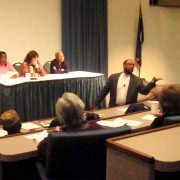
After hearing Lonnie Bunch, Director of the National Museum of African American History and Culture (NMAAHC), speak on the topic of collaboration at the 2007 Smithsonian Affiliations National Conference, we knew that we would like to work and collaborate with this new and forward-looking Smithsonian museum in the future.  I mentally filed away many of Mr. Bunch’s comments and ideas as well as the overall vision of the NMAAHC, which specifically addresses collaboration as a core value of the institution.  Indeed, on the homepage of the NMAACH’s website, “collaboration” is one of the main tabs along with collections, education, etc.   The opportunity to work with NMAAHC and our fellow Carolinas’ Smithsonian Affiliates presented itself this spring as part of a joint state museum conference between North and South Carolina.   Working with the staff at NMAAHC and the Affiliations Office, we were able to bring Dr. Rex Ellis to the Carolinas on March 4-5, to present both an afternoon workshop and to deliver the keynote address for the conference.  Dr. Ellis presented an outstanding program focusing on the challenges of interpreting slavery.  His presentation provided his audience of museum staff and volunteers with much food for thought – challenging us to consider different perspectives.  His keynote address was equally stimulating as he wove song, personal stories, and professional experience into an elegant vision for the future of museums. 

Not only was the conference a collaboration between states, but in order to bring Dr. Ellis, we reached out to our Smithsonian Affiliates in the Carolinas for their support.  The Carolinas’ Smithsonian Affiliates came forward and helped to support this initiative both monetarily as well as through staff attendance.  We hope that this may be the beginning of more inter-Affiliate collaborations.

In these difficult economic times, collaborations are one tool which we can utilize to better serve our communities.  Reflect on your institution’s current collaborations as potential partnerships for the future

To put it plainly, you can never have too many friends.

stimulus funding

Do you qualify for stimulus funding?

stimulus.jpg 

Searching for research funding? Grant opportunities are available! The American Recovery and Reinvestment Act of 2009 has budgeted for numerous grant funding opportunities representing agencies government wide. Each agency has been allocated varying amounts of money to support research in all different fields of studies.

For the latest information regarding Recovery Act grant announcements please visit their website at Grants.gov then click on ‘Recovery Act Opportunities’ which provides a listing of every agency’s recovery act website.

and good luck!

Museum Transparency

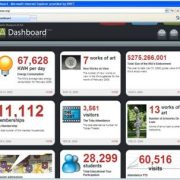
Indianapolis Museum of Art Dashboard

SI Staff were treated last week to a lecture by Max Anderson, director of the Indianapolis Museum of Art.  He kicked off his lecture with a “memo” by President Obama urging transparency not only in  government, but across all organizations.  Anderson then made quite a cogent argument for greater transparency in the museum world. 

He argued, for example, that the statistics often cited for success by museums – attendance, membership – are often misleading and meaningless to society as a whole.  So what matters then?  Anderson suggested that issues like:  how we steward the environment and teach others to do so; how well we remain vigilant about Nazi-era and Antiquities provenance research; even, how is what we serve in our museum cafes improving or exacerbating visitors’ health?

Anderson addressed this issue at his museum with a dashboard.  This device provides lots of statistics to a range of museums metrics – where visitors come from, the size of the Museum’s endowment, new works on view, among other stats. 

Why do this?  Another question may be, why not?!  As he said, making this kind of information readily available forces the staff to engage in constant vigilance and performance improvement, and lets visitors know what the Museum cares about.  It builds trust both inside and outside the organization.

The final nail to this argument came when Anderson reminded the audience that in the first round of the recent stimulus bill, museums were lumped in with casinos as being exempt from receiving stimulus funds.  Luckily, museums were taken off the list, but the obvious question was, what are we doing (or not doing) to have lost such a critical societal distinction?

The Smithsonian was forced to become more transparent recently as the press well documented, and we all agree we are better for it.  You can now watch Regent Meetings for example, and read our Governance Scorecard, among other improvements.  And, you can watch all of Anderson’s talk here.

Has your museum taken any recent steps in regard to transparency? 

The Other 90% in Atlanta

Thanks to Louise Shaw, Curator, Global Health Odyssey Museum, Centers for Disease Control and Prevention, for this guest post.

Photo credit: Jim Gathany, Centers for Disease Control and Prevention

As curator of the Global Health Odyssey Museum at the Centers for Disease Control and Prevention [CDC] in Atlanta, I had the challenging and exciting task of designing and installing Design for the Other 90%. This traveling exhibit was curated by Cynthia Smith of the Smithsonian’s Cooper-Hewitt, National Design Museum in New York City, and “features more than 30 projects that reflect a growing movement among designers, engineers, and social entrepreneurs to create low-cost solutions for everyday problems,” targeting 90% of the world’s 6.5 billion people who “have little or no access to most of the products and services many of us take for granted.”

Context is everything.

As one of the world’s leading public health agencies, CDC is committed to achieving true improvements in all people’s lives, and we walk the walk. This explains why the Global Health Odyssey Museum was interested in mounting Design for the Other 90%. At CDC, we believe that poverty, whether abroad or in the U.S., is directly linked to health gaps, disproportionately affecting certain populations, as well as geographic regions. Any effort to improve global health must also holistically address issues of education; shelter; access to water, food, and technology; affordable transportation; economic opportunities; and sustainability.

So, what an opportunity Design for the Other 90% has been. We are engaging with CDC staff members who actually have been deeply involved in the issues brought up in the exhibit, as well as the evaluation and distribution of some of the design objects on display. The exhibit has also drawn tremendous interest from educational institutions such as the Georgia Institute of Technology and Savannah College of Art and Design, and from the entire Atlanta design community.

Because the original installation was mounted totally outside on the CH’s grounds, each host institution was tasked to create a new and unique design plan, and fabricate its own exhibit display elements. We had a great time figuring out how to display objects ranging from a latrine slab used in refugee camps in East Africa to a house for the homeless made by the Atlanta-based Mad Housers to treated bednets. Our entire design and fabrication team really rose to the occasion, using warehouse crates for pedestals, building floor trays to display objects such as water pumps, and even appropriating a piece of 1000-pound concrete as a base for a 12′ solar lamp post!

At the end of the day, by highlighting innovative designs meant to improve the lives of all, we have been able to acknowledge our collective responsibility for both solutions and actions. Like the previous hosts of the exhibit–the Walker Art Center in Minneapolis and the Ontario College of Art and Design in Toronto, Canada–we are committed to exploring issues of social change and justice that will allow the world’s populations to live the best lives possible.

To learn more about this exhibition and its travel schedule, visit it online at https://other90.cooperhewitt.org/ 
or email Cynthia Smith at SmithCynthia@si.edu.  

Kansas City – Jazz, BBQ and Beyond

Thanks to Andrew Zender, Director of Communications at the American Jazz Museum, for this guest post.

18th & Vine, Kansas City.  Photo credit: Diallo French

Born in America, jazz is our nation’s only indigenous art form and one of our greatest treasures.  Kansas City is one of the important incubators of jazz, and within its borders is one of the greatest crossroads of American music and culture: 18th & Vine.

From the swinging clubs and the all-night jam sessions to the exciting Negro Leagues baseball games, 18th & Vine was buzzing with a unique force, a scene ripe with riffs, built upon jumpin’ jazz blended with blues, Bird’s blossoming bebop – and Kansas City’s signature swing.

However, there were many other equally important aspects of life in the Historic 18th & Vine Jazz District – people and places that were woven into the social fabric that made 18th & Vine and a legendary spot forever immortalized in song and in the memories of folks who worked, lived and played here, some of whose stories are still to be told – until now.

Recognizing a need for the recording and preservation of dozens of untold oral histories that chronicle an incredibly important period of American life, the American Jazz Museum, one of the cultural anchors of the Historic 18th & Vine Jazz District, has launched a new initiative aimed at capturing theses stories in a series entitled Stories from the Vine.

Featuring compelling narratives of life at 18th & Vine during its golden age from community members, local scholars/historians and other special guests, Stories from the Vine is designed to reveal new insights, provide a public forum and record testimonies documenting the rich legacy of the Historic 18th & Vine Jazz District.

Using the District as a backdrop, Stories from the Vine will explore a variety of topics ranging from music and sports to business and politics, highlighting the role of 18th & Vine in Kansas City as an incredible hub of culture, commerce and entertainment. 

The program kicked off in February 2009 with three sessions exploring Black History Month, and will continue in March focusing on Women’s History Month and Women in Jazz. April sessions will be centered on the nationwide celebration of Jazz Appreciation Month.  Community members are invited to attend the free sessions and encouraged to share their own memories, which will be professionally audio/video recorded for compilation and future public exhibition. 

The Historic 18th & Vine Jazz District’s legacy is held up by two separate but deeply intertwined pillars – jazz and baseball – but there are many more layers to be uncovered in order to reveal a complete history.  The accounts of the local community are integral to nurturing a historical record that primarily remains carried on through oral tradition. 

The knowledge and appreciation gained from Stories from the Vine are invaluable in establishing a comprehensive, engaging and fully accessible permanent record of Kansas City as well as American musical and cultural history.

(More information on this program is available online at americanjazzmuseum.org or by calling the American Jazz Museum at 816-474-8463).


In Plane View at Kansas Cosmosphere

Chuck Yeager's Bell X-1 Glamorous Glennis

The Kansas Cosmosphere and Space Center, our Smithsonian Affiliate in Hutchinson, Kansas, served as the perfect backdrop for the opening stop of the national tour of In Plane View/Abstractions of Flight, a traveling exhibit from the National Air and Space Museum, featuring the remarkable photographs of Smithsonian photographer, Carolyn Russo. As a guest attendee on January 30, I found myself in awe of the creativity that surrounded me.  The Cosmosphere is a tribute to the educational creativity of Patricia Brooks Carey, who in 1962 started a small planetarium on the grounds of the Kansas State Fair, in what was described to me as “an old chicken coop.”  The chicken coop became the Cosmosphere in 1980, and has since grown into the second largest collection of US space artifacts in the world, and the largest collection of Soviet space artifacts outside of Moscow.  More than 125 objects on loan from the Smithsonian’s National Air and Space Museum help tell the story, among them the Liberty Bell 7 spacecraft and Apollo 13 command module.  

Russo’s creativity comes from an unmatched gift for seeing designs and patterns in airplanes and spacecraft and for translating them into alluring and thought-provoking photographic images.  In Plane View consists of 56 large-format photographs that remind us that machines of flight are more than hunks of riveted metal attached to large engines, and flown only by the fearless.  They are, through Russo’s artistry, artifacts imbued with mystical geometries, strange symmetry, sensuous curves, and bold colorations.  What Amelia Earhart called “the aesthetic appeal of flying” comes through in unusual and unexpected bursts in Russo’s photographs.  Chris Orwell, director of the Cosmosphere, and his staff did a terrific job of mounting the exhibition and hosting the opening reception.  The photographs were hung with  exceptional care, and stood out wonderfully under the newly installed lighting system.  With a soft harp playing in the background, guests including Alan Shepherd’s daughter, Laura Churchley, enjoyed conversing with Russo, who also signed copies of the book that accompanies the exhibit.  

Nearby, I couldn’t help but notice a lone exhibit case housing a battered old star-making device, recently recovered from a local school that turned out to be the original projector from the first planetarium shows at the “old chicken coop.”  Though a bit rusty and worn, it too spoke of creative impulses – the kind that start at the edges of our universe and reach deep down into the curiosity within each of us.   Carolyn, the Cosmosphere, and the chicken coop brought us together that night in a memorable and inspiring way.  Isn’t that what museums are supposed to do?  

Smithsonian Affiliates will continue to enjoy In Plane View/Abstractions of Flight when it visits The Air Zoo (Kalamazoo, MI), Frontiers of Flight (Dallas, TX), The Works:  Ohio Center for History, Art & Technology (Newark, OH), College Park Aviation Museum (College Park, MD), Lakeview Museum of Arts and Sciences (Peoria, IL), and Challenger Space Center (Peoria, AZ).  I hope you’ll have a chance to soar with it.