Dive into Deep Space

A glimpse at the Black Holes exhibition.

a glimpse into the Black Holes exhibition

Black holes are regions in space with gravity so powerful that nothing can escape, and where time and space are warped beyond our understanding. A new traveling exhibition from the Harvard-Smithsonian Center for Astrophysics will guide visitors on a journey to the edge of these strange objects to discover how the latest research is turning science fiction into fact, challenging our notions of space and time in the process.

Created by educators and scientists at the Center for Astrophysics (CfA), Black Holes: Space Warps & Time Twists is an exploration of the most mysterious and powerful objects in the universe. It opened at the Boston Museum of Science, and is now available to travel.

Project director Mary Dussault explains, “In this exhibition, we wanted to use the inherent fascination of black holes as a compelling vehicle to engage museum visitors in the larger story of how scientific discovery works–and how science is connected to human curiosity, imagination and culture.”

The interactive stations in the 2,500-square-foot exhibition address a number of questions:

    What is a black hole?
    Where are they?
    How do we find black holes if they are really black?
    What would happen if you were sucked into one?

One station allows visitors to experience their own black hole adventure. Using one of three “excursion pods,” visitors will embark on a fantasy “adventure vacation” to the black hole at the center of our own galaxy. As they make their way toward this “deep space dive,” travelers explore the phenomena around the black hole, including warped space, the slowing of time, and the dangerous magnetic fields and radiation that could leave them stranded on their cosmic adventure.

The exhibition is being traveled by the Association of Science – Technology Centers, and is available to Smithsonian Affiliates at the members’ price. Affiliates also receive exclusive access to CfA staff, including a special lecture from a Smithsonian scientist working with the Chandra X-ray Observatory (the world’s best black hole hunting machine); and the opportunity to collaborate with educators from the Smithsonian Astrophysical Observatory to offer a special teacher workshop to their local school-based audiences, among other programming. 

Headquartered in Cambridge, Massachusetts, the Harvard-Smithsonian Center for Astrophysics is a joint collaboration between the Smithsonian Astrophysical Observatory and the Harvard College Observatory. CfA scientists, organized into six research divisions, study the origin, evolution and ultimate fate of the universe.
Share and Share Alike

This morning I had the pleasure of talking about the Affiliations program with staff from two Affiliates, the Heinz History Center and the B & O Railroad Museum.  But we weren’t talking about the Smithsonian’s Affiliations program – we were talking about theirs.

borail

Both the Heinz History Center and the B & O Museum have created Affiliate programs, which were the topic of a panel discussion today entitled “Share and Share Alike” at the Pennsylvania Federation of Museums and Historical Association’s annual meeting in Gettysburg.  Their programs are structured very differently, which made for an interesting compare and contrast in regard to costs, benefits and challenges.  But we discovered many commonalities too.

The Heinz Center’s Affiliate Program (HCAP) encompasses historical societies, libraries, museums, even cemeteries across Western Pennsylvania.  Nearly 100 organizations have affiliated with the History Center, seeking help and advice on issues ranging from cleaning metal objects to writing label copy.

The B & O Railroad Museum’s program is more formal and structured, a tiered approach with escalating benefits that include discounts on branded retail items and reduced admission for members.  Contrary to expectations, the B & O’s affiliates are not limited to other railroad museums; it also attracts historical societies with ties to the railroad industry in West Virginia and Maryland.

But both programs have alot in common.  It takes the entire staff of both museums to make the program work, and staff members are committed to sharing their expertise and providing a range of services to their affiliate networks.  They agree that a primary difference between their Affiliate programs and other types of associations or memberships (AASLH or AAM for example), is the opportunity to share artifacts.  Truly, nothing can replace the power of the real thing, as every museum professional knows.  hcaptree

We were fortunate to have a staff member from one of the Heinz Center’s Affiliates in the audience, who provided an insight that I’m confident B & O’s Affiliates share.  More than anything, she appreciated the access to personalized, customized, one-to-one mentoring available through the program.  Nothing can replace the power of that kind of relationship either.

Smithsonian’s fireless locomotive moves to Baltimore

locomotive-in-storage1

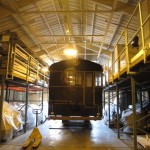
locomotive in Smithsonian storage, waiting for its trip to Baltimore


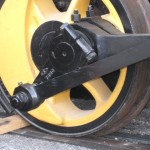
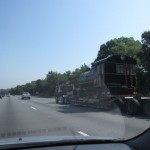
 The Smithsonian’s National Museum of American History recently donated a vintage 1938 fireless steam locomotive to our Affiliate in Baltimore, the B & O Railroad Museum.  On August 18, Affiliations and Museum staff were on hand to document this dramatic move.

 The move took two days to complete.  One to rig the locomotive onto a palette inside the American History Museum’s storage facility, and another day to load it onto a truck, drive it to Baltimore, and unload it in the restoration shop of the B & O Museum. 


IMG_0816

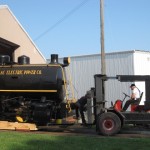
a special forklift eases the locomotive out of storage. very slowly.

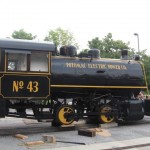
The locomotive was built by the Heisler Locomotive Works in Erie, Pennsylvania for the Potomac Electric Power Company (Pepco) in 1938. Unlike other steam engines, this unique 35-ton locomotive did not need a fire to produce steam; instead it was filled with steam and superheated water from the power plant’s boilers under high pressure at temperatures around 400 degrees Fahrenheit. The locomotive was capable of operating by itself for approximately five hours on one charge of steam and superheated water. 


IMG_0870

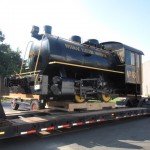
lifting the locomotive onto its ride, a flatbed truck

Bill Withuhn, Smithsonian Curator of Technology and Transportation, contacted the B&O Railroad Museum more than a year ago to begin negotiations for the transfer of the locomotive to Baltimore. “The fireless was a trusty workhorse locomotive; one that deserves to be on exhibition for its contributions to lighting Maryland and the nation’s capital. We are pleased to make possible this transfer to our affiliate.”


In the U.S., fireless locomotives ran exclusively on the networks of tracks located within the boundaries of some of the largest coal-fired power stations operated by utilities. The locomotive needed to remain close to the power plant in order to be recharged. An early example of green technology, the fireless steam locomotive emitted only steam vapor, unlike other locomotives which release smoke exhaust.


B&O Railroad Museum Executive Director, Courtney Wilson said, “This locomotive is a scarce type of railroad motive power not represented in our unparalleled collection of 19th and 20th century steam locomotives. It fills an important gap and we are extremely pleased to accept this gift from the Smithsonian.”
  
IMG_0900

we got alot of curious looks cruising on I-95

From 1938 until 1974 the Pepco locomotive operated at the Buzzard Point Power Station in Washington, D.C. hauling coal. From 1974 to 1978 it was used at the Potomac River Power Station in Alexandria, Virginia. In 1979 Pepco restored and donated the locomotive to the National Museum of American History’s Work and Industry collection where it has been in storage.  Until now. 

On October 15, the B & O will roll the fireless locomotive into its famous roundhouse to celebrate its 10th anniversary as a Smithsonian Affiliate.  There it will join other Smithsonian artifacts on loan to the Museum, including 50 models of historic locomotives and railway cars and the boiler from the first locomotive used in the Western Hemisphere, the Stourbridge Lion. 
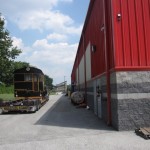
rounding the corner to the back door of B & O's storage facility

rounding the corner to the back door of B & O's storage facility. almost there!


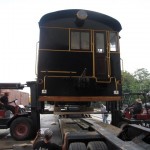
2 forklifts hold the locomotive in mid-air, while the flatbed truck drives out of the way.

2 forklifts hold the locomotive in mid-air, while the flatbed truck drives out of the way

easing it off its palette, a few inches at a time

easing it off its palette, a few inches at a time

hitting the rail!

hitting the rail!

See more photos in the Smithsonian Affiliates group pool on flickr.

grab your compass

historyexplorer.americanhistory.si.edu


Affiliates Plimoth Plantation and the Senator John Heinz History Center extend their reach through Smithsonian’s History Explorer and Thinkfinity!

Smithsonian’s History Explorer is a gateway to innovative, standards-based online resources for teaching and learning American history.  History Explorer is designed and developed by the National Museum of American History, a partner in Verizon’s Thinkfinity.org consortium of leading national education experts. The National Museum of American History is an integral part of Verizon’s Thinkfinity.org consortium. 

Teachers need only to visit Thinkfinity.org to search free educational resources from all of the partners. Thinkfinity is a free, comprehensive digital learning platform for high-quality education content, and serves as a portal for millions of American teachers, parents, and students.  The site makes it easy for educators to enhance their classroom instruction with lesson plans, interactive activities, and other online resources.

Now, the unique resources of two Smithsonian Affiliates will be added to History Explorer and will be Smithsonian recommended resources on Thinkfinity.org.  You Are the Historian, from Plimoth Plantation, investigates the first Thanksgiving and what really happened at the 1621 harvest celebration.  The Heinz History Center’s Worlds in Motion examines the complexities of interaction among eastern American Indians, colonists and Europeans from pre-contact through colonial times.

Affiliates, do you have exemplary or unique materials on American history that you would like to share?  To nominate your resource or website, or to find out more about the process, please contact your outreach manager

climate change online conference

Ginkgo biloba  Ginkgo biloba

The Smithsonian addresses the global challenge of climate change in a range of ways, including through exhibitions and scientific research. 

From September 29 through October 1, 2009, the Smithsonian will offer an education online conference on climate change to allow teachers and the general public to participate in the Institution’s investigations, meet and question Smithsonian curators and scientists, and deepen our understanding of this critical issue.  Alongside Smithsonian scientists and curators, you’ll look at the issues surrounding climate change from the perspectives of science, history, and art. Registration is free, and now open.  

The conference is broadly organized around three topics: Evidence, Impact, and Response to climate change.  Participants will sample  some fascinating Smithsonian research–everything from an artist’s attempts to document sustainability issues, to a paleoclimatologist’s findings about prehistoric climate change and why it matters, to a discussion about how polar bears are faring in our warming world. 

Curators, researchers, and educators from the Archives of American Art, the National Museum of American History, the National Museum of the American Indian, the National Museum of Natural History, the Smithsonian Environmental Research Center, the Smithsonian Tropical Research Institute, and the National Zoo will conduct twelve different live sessions, and several other units will deliver content in a “virtual exhibit hall.”  The conference features talks, interactives, and resources such as lesson plans and classroom activities, to help make this knowledge as accessible and usable as possible. (See the full agenda.)

 Affiliations is pleased to acknowledge the participation of educator Paisley Cato from the Western Center for Archeology and Paleontology, our Affiliate in Hemet, California.  Paisley worked side-by-side with Smithsonian educators throughout the summer to develop educational materials to complement the conference.

How can Affiliates be involved?  Like the virtual conference on Abraham Lincoln which took place in February (replay at smithsonianeducation.org/lincoln), Affiliates are encouraged to act as hosting sites for shared viewing and discussion with their  local area teachers, educators, and the scientific community.  Follow and comment on the climate change blog, or follow updates on Twitter (#SIClimate) and Facebook (Smithsonian Education).  

Show me the money

In these tough economic times, it’s nice to see some bright spots.  
Congratulations to all these Affiliates who’ve received grants and awards recently.  Well done!

Ohr-O’Keefe Museum of Art has been awarded a $25,800 grant from the Mississippi Arts Commission (MAC) to support ongoing education and exhibition programming.

The American Civil War Center at Historic Tredegar has received a $3,000 grant from the Preservation Fund of the National Trust for Historic Preservation to assist with a condition assessment of historic structures on the Center’s 8.3-acre property. 

Birthplace of Country Music has received approval of $1.7 million by the Special Projects and Innovation Committee of the Virginia Tobacco Indemnification and Community Revitalization Commission for the development of the new museum.


The Institute of Museum and Library Services announced the recipients for the Museums for America grant program including the following Affiliate organizations and their projects:

The National World War II Museum received $150,000 to help finance live performances at the museum including music and entertainment from the World War II era and modern pieces inspired by the war.

B & O Railroad Museum received $110,000 for their “Whistlestop Gateway Project” to develop an interpretive program and a regular rail link to the west end of the museum’s 40-acre campus.

Kansas Cosmosphere and Space Center received $137,373 to develop a 4,000-square-foot immersive and interactive exhibit on space exploration from the 1970s into the future.

Michigan State University Museum received $136,323 to complete critical database and technological enhancements for its natural history and cultural collections including imaging more than 10,000 ethnographic objects to the Web.

Durham Museum was awarded $122,850 to digitize and preserve its photo archive collection, which consists of approximately 500,000 images reflecting the history of Omaha, Nebraska.

Nevada Test Site Historical Foundation’s Atomic Testing Museum was awarded $34,933 to conduct a planning project based on establishing a best practices approach to the day-to-day business of the organization that will enhance the capacity of the organization to better serve the southern Nevada cultural and educational community.

Historic Bethlehem Partnership received $57,650 to inventory, pack, and move the collections of the Kemerer Museum of Decorative Art to a new Collections Resource Center.

Heinz History Center was awarded $90,859 for the Life in Western Pennsylvania: A Digital History Resource project to address the critical need for assessment tools for planning digital history sites and measuring the impact of online resources to increase the use of archival collections.

Culture and Heritage Commission of York County received $148,875 to transform the Museum’s static natural history dioramas and exhibits into active, inquiry-based learning experiences by using real specimens and scientific investigation and to create a curriculum-based program for middle school students that meets state curriculum standards.

Wing Luke Memorial Foundation was awarded $150,000 to support Art Beyond Downtown, an initiative to engage new visitors, create opportunities for them to learn about art, culture, and history related to Asian Pacific Americans, and to encourage them to return to the museum and its neighborhood.