50th Anniversary of the Freedom Rides

Special thanks for this guest post to Allyson Nakamoto, Teacher Programs Manager at the Japanese American National Museum (Los Angeles, California).

Panelists (L to R): Robert Singleton, Helen Singleton, Sybil Jordan Hampton (moderator), Tamio Wakayama

I often take for granted how easy it is to follow breaking news. To find out what happened during a raid on a compound in Pakistan, I can turn on a 24-hours news channel or click on a few links to get caught up.

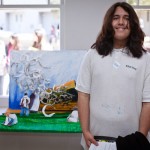
Student with his artwork inspired by the Freedom Rides

But 50 years ago the medium of television was new.  And 50 years ago today, the first buses of Freedom Riders (and three reporters) left Washington, D.C. and headed South to test Boynton v. Virginia, the U.S. Supreme Court decision that had desegregated interstate travel. What followed changed the course of the United States history.

The Freedom Rides have been on our minds a lot this year.  On February 9, 2011 the Smithsonian Institution’s National Museum of American History organized a Web cast and National Youth Summit that brought together Freedom Riders in D.C. and engaged five Smithsonian Affiliates from across the nation to discuss the meaning of the Freedom Rides and the role of young people in shaping America’s past and future.

JANM was honored to have been selected as the West Coast venue for this program and streamed the Webcast to a live audience of students from LAUSD’s Civitas School of Leadership and Ribet Academy. Following the Webcast, Dr. Robert and Mrs. Helen Singleton, two Los Angeles-based Freedom Riders, and Mr. Tamio Wakayama, a Japanese Canadian member of SNCC, were on a panel moderated by Dr. Sybil Jordan Hampton, a member of JANM’s Board of Trustees and herself an important figure in the Civil Rights Movement. We were star struck!!!

This has gotten us thinking about how the Freedom Rides impacted Japanese Americans, and especially how it may have emboldened those in the Redress Movement. What were the Issei, Nisei, and Sansei who watched these images broadcast on national television (just as that medium was becoming commonplace) thinking and feeling as they watched the buses burning, the cruel racism, and brave individuals standing up for what was right?

What would you have been thinking if you had been watching those Freedom Riders make their way South under the “protection” of Boynton v. Virginia?

P.S. To learn more about the Freedom Rides, tune into your PBS station on May 16 and also we highly recommend The Children by David Halberstam. Learn more about new generation of young people who are about to retrace the path of the Freedom Riders. And, maybe you can catch a glimpse of the Singletons when Oprah Winfrey reunites the Freedom Riders on May 4.

Photographer: Tracy Kumono

what’s the big [education] idea?

In keeping with this year’s education theme at the annual Smithsonian Affiliations National Conference, we’ll be hosting a series of roundtable discussions in a session titled “What’s the Big Idea: Revitalizing Education Through Partnership and Collaboration.” 

 This dynamic session will follow a format well-known to most  museum professionals.  Smithsonian colleagues from across the Institution will present at their tables for 10 minutes each about their current projects, with the express goal of encouraging ideas for collaboration or input from Affiliates.  After the talks, all participants at the table – Smithsonian and Affiliate staff – will be encouraged to brainstorm ideas and next steps on ways to participate, partner, or stay in touch as projects develop.  During the last half hour, we’ll ask a representative from each table to “share out” so everyone in the room can reap the benefits of every table’s discussion.

Each table represents a theme that Smithsonian educators are thinking and talking about at our own meetings and workshops.  The Smithsonian educators form an array of content across art, science and history, and will be addressing the following themes:

  • Education technology
  • Dedicated spaces for education
  • Citizen Science/Citizen History programs
  • Early Childhood Education in museums
  • You + Your Schools + the Smithsonian. 

Affiliate conference attendees are encouraged to consider the project descriptions attached here, and to join that table that best aligns with their home museum’s strengths and interests.

We anticipate a lively and fruitful discussion, and hope to see you there!    

coming up in Affiliateland, May 2011

Sliding into summer with lots of activity!

FLORIDA:
The South Florida Museum opens SITES’ Hidden Life of Ants in Bradenton, 5/7.

PENNSYLVANIA:
Smithsonian researcher Warren Perry presents a lecture on “William E. Doster’s Defense of the Lincoln Conspirators” at the Historic Bethlehem Partnership in Bethlehem, 5/8.

MONTANA:
Dr. Rick Potts, Director of the Human Origins Program at the National Museum of Natural History will lead a workshop and lecture focused on human evolution at the Museum of the Rockies in Bozeman, 5/13.

CONNECTICUT:
Hunt Hill Farm celebrates Steinway in May with Anna Karvellas, project director for the Steinway Diaries exhibition at the National Museum of American History, presenting a lecture on “The William Steinway Diary,” 5/14.  Smithsonian Scholar Robert Wyatt will speak on Steinway artists past and present in New Milford, 5/21.

CALIFORNIA:
Riverside Metropolitan Museum celebrates “Smithsonian Week” in Riverside, 5/19.

TEXAS:
The Women’s Museum: An Institute for the Future will display a painting by Lois Mailou Jones, on loan from the National Portrait Gallery, in its exhibition, Loïs Mailou Jones: A Life in Vibrant Color in Dallas, 5/21.


affiliates collaborate to Spark! imaginations

Despite being the world’s largest museum complex, one of the challenges at the Smithsonian Institution remains taking the unique offerings away from the invisible walls of the National Mall and “encourage inventive creativity in young people” who may never visit Washington D.C.

The Smithsonian’s Lemelson Center for the Study of Invention and Innovation has met this opportunity head on by launching the Spark!Lab Outreach Kit Project, through a distribution of six organizations including five Affiliate museums. This collaboration is seen as an effort to extend the reach of Spark!Lab–the center’s hands-on invention activity center–beyond the boundaries of the National Museum of American History. The kits will be designed to replicate some of the most popular Spark!Lab activities and provide opportunities for partner museums to connect their collections and exhibitions to themes of invention and innovation.

The Spark!Lab kits will test and engage students in a variety of interactive stations including “Shaping Space,” a structure building activity; “Now What?,” a problem-solving game; “Snap Circuits,” which gives visitors the chance to use real circuit components to create and test their own electric inventions; and “Soundscapes,” which encourages children to use items, including musical ramps, xylophone staircases and bridges with bells, to create music and sound pathways for marbles. The “Spark!Lab Jr.” program helps learners under the age of 5 develop inventive thinking and problem-solving skills. 

“At the Lemelson Center we believe that a playful approach to problem solving can spark new ideas and lead to great inventions,” said Arthur Molella, director of the center. “This outreach project allows us to reach children outside of the National Mall in Washington, D.C., and inspire a new generation of inventive Americans.”

During this pilot program, Spark!Lab kits will be featured at the following Smithsonian Affiliate museums-the U.S. Space and Rocket Center in Huntsville, Alabama, Annmarie Garden in Solomons, Maryland, the Western Science Center in Hemet, California, the Museum of Arts and Sciences in Daytona Beach, Florida, and the Science Museum Oklahoma in Oklahoma City.

“Science Museum Oklahoma is excited to partner with the Smithsonian and offer a new challenge to our younger guests!” said Suzette Ellison, vice president of Programs and Interpretation at the museum.

An educator at Annmarie Garden inventing with a Spark!Lab kit

“We are very excited to introduce the Spark Lab kits in our classrooms,” said Jaimie Jeffrey, Education Director at Annmarie Garden. “As an arts center, teaching children to apply creative problem-solving skills and innovative thinking to everything they do is paramount for us. These kits are great reinforcements for these strategies in all of our kids’ and family programs.”

The Lemelson Center expects to develop an online Spark!Lab “tool kit” based on evaluations and ‘lessons learned’ from the in-museum activity kits. The on-line content will outline Spark!Lab’s educational philosophy, mission, and vision, and will include simple at-home activities and a list of additional resources for parents and kids.

The Spark!Lab Affiliate program is supported by a gift from the LEGO Children’s Fund.  And be sure to meet the Spark!Lab staff at the annual Smithsonian Affiliations National Conference in June.

NASA + Smithsonian + Smithsonian Affiliates = Blissful retirement for space artifacts

Space Shuttle Endeavour is moments away from touchdown at the Kennedy Space Center's Shuttle Landing Facility, bringing to a close the STS-113 mission to the International Space Station. Image credit: NASA

On April 12, 2011 NASA announced new homes for three space shuttles soon to be retired from the space program at the end of this summer. The Smithsonian’s National Air and Space Museum Steven F. Udvar-Hazy Center   will receive the Discovery and the California Science Center  a Smithsonian Affiliate in Los Angeles, California,  will receive the Endeavour.  

But NASA isn’t just retiring the gigantic shuttles.  Hundreds of space artifacts are also included in the retirement plan and several more Smithsonian Affiliates will have the honor of exhibiting them.   

  • The Adler Planetarium & Astronomy Museum (Chicago, Illinois) will receive various shuttle simulators.
  • The Evergreen Aviation and Space Museum (McMinnville, Oregon) will receive an orbital maneuvering system engine and various shuttle simulators.
  • The Museum of Flight (Seattle, Washington) will receive a full fuselage trainer. 
  • The U.S. Space and Rocket Center (Huntsville, Alabama) will receive a space shuttle orbital maneuvering engine.

 These NASA objects join Smithsonian National Air and Space Museum (NASM) artifacts already on long-term loan to these Affiliates and enjoyed daily by museum goers across the country.

The Saturn V Rocket at the U.S. Space and Rocket Center. Photo courtesy U.S. Space and Rocket Center.

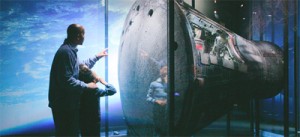
  • At the Adler Planetarium, visitors can see the Gemini 12 Space Capsule flown by Jim Lovell and Buzz Aldrin in 1966.
  • The Aerobee 350 Sounding Rocket has recently been conserved at the Evergreen Aviation and Space Museum and will be on view for visitors to the museum soon. 
  • From space food to drawings to space suits, The Museum of Flight has delighted visitors to the museum with NASM artifacts for many years.
  • The U.S. Space and Rocket Center is home to the Saturn V Rocket and many other artifacts such as space instruments and technical devices.

 Of course, the history of the American space program and many more historic artifacts from the National Air and Space Museum can be can be seen in numerous Smithsonian Affiliate museums from Portage, Michigan to San Diego, California.  There are 168 Smithsonian Affiliates in 40 states, D.C., Panama and Puerto Rico.  More than 1,000 artifacts are currently on view at Affiliates across the country just waiting for visitors to experience the Smithsonian in their own neighborhood.  Visit a Smithsonian Affiliate in your community today!

Gemini 12 at the Adler Planetarium in Chicago. Photo courtesy Adler Planetarium & Astronomy Museum.

coming up in Affiliateland in April 2011

Hello spring!   Like the cherry blossoms in D.C., activities at Affiliates are budding all over the country in April.

MARYLAND:
The
Smithsonian Associates presents a public tour, “The Birthplace of American Railroading,” at the Baltimore and Ohio Railroad Museumin Baltimore, 4/2.

The B & O Museum will also open The War Came by Train, an exhibition commemorating the 150th anniversary of the Civil War, and featuring the 1851 Pioneer locomotive, on loan from the National Museum of American History and recently restored by the B & O Museum, 4/14.

National Museum of American History curator Nancy Davis will serve on the jury panel for the upcoming Supersize exhibition at Annmarie Garden, 4/8.

COLORADO:
NASM curator Michael Neufeld will give a public lecture and book signing for the National Air and Space Museum: An Autobiography at the Littleton Museum in Littleton, 4/6.  

VIRGINIA:
National Museum of Natural History curator Doug Owlsey will present the keynote lecture for the VMNH Foundation Thomas Jefferson Awards at the Virginia Museum of Natural History in Martinsville, 4/8.

PENNSYLVANIA:
Smithsonian Under Secretary for History, Art and Culture Dr. Richard Kurin will present a 10th Affiliate Anniversary Plaque to the Senator John Heinz History Center in Pittsburgh at their annual History Makers Award Dinner, 4/8.

CALIFORNIA:
Riverside Metropolitan Museum will feature a modern quilt on loan from the National Museum of the American Indian in its upcoming exhibition American Indian Women Artists: Beyond Craft, opening in Riverside, 4/7.

LA Plaza de Cultura y Artes will celebrate the opening of their new building with an exhibition including artifacts on loan from the National Museum of American History in Los Angeles, 4/15. 

NEW YORK:
National Postal Museum curator Cheryl Ganz will present a public lecture, “Fan Dancing and Fan Belts: Selling Optimism at the 1933 Chicago World’s Fair” at The Long Island Museum of American Art, History & Carriages in Stony Brook, 4/10.

NORTH CAROLINA:
The Charlotte Museum of History opens SITES’ Becoming American: Teenagers and Immigration exhibition in Charlotte, 4/23.

FLORIDA:
The South Florida Museum and Parker Manatee Aquarium opens SITES’ Farmers, Warriors, Builders:  The Hidden Life of Ants exhibition in Bradenton, 4/30.