Museums’ Futures Rely on Relevance

Special thanks to Ellen Rosenthal, President and CEO at Conner Prairie Interactive History Park, a Smithsonian Affiliate in Fishers, Indiana, for this guest post.

Around 500 BCE the legendary Greek philosopher Heraclitus declared that the only constant is change. Imagine what he would say today. 

For more than a quarter century museums have been a central part of my life (Conner Prairie Interactive History Park since 1999).  It’s safe to say that I expected the world to change during my career, but at this rate?  In retrospect, I was clueless. 

Entering Dupont, part of the 1863 Civil War Journey at Conner Prairie. Photo courtesy Conner Prairie.

We museum leaders find ourselves in the midst of a digital revolution, globalization, new discoveries in the way people learn and retain information, the manner(s) in which information is conveyed,  economic challenges (for us and for our guests), and attention spans that seem to shrink with the launch of every new Smartphone app.  

So what are we to do with this tsunami of challenges facing our industry if we are to avoid being relegated to another heap within history?   

Museums must not only find ways to engage today’s sophisticated and restless consumers, but we must recognize a shared need to remain relevant – to keepup with change.  My 20-year-old son once challenged me, “Why do I need to go to Conner Prairie when I can experience time-travel on my laptop?” Conner Prairie has an answer. 

The Depot in the 1863 Civil War Journey at Conner Prairie. Photo courtesy Conner Prairie.

The shared purpose that we embrace at Conner Prairie is to create intergenerational learning “exhibits” that pique curiosity, generate positive attitudes toward learning and encourage grandparents, parents, teachers and children to share experiences that spark conversation. 

Although there are no long-term studies to prove the importance of museums to educational attainment, research on the summer learning gap shows that underprivileged students fall behind their middle-class classmates, because they do not visit museums or have other out-of-school learning experiences over the summer. There is an important role for museums to play in sustaining America’s educational competitiveness.  

Conner Prairie seeks to make it easier for entire families of all income levels to share learning experiences by first, making those experiences exciting enough to leave home for, and by second, offering reduced admission based on need through the Access Program, which offers $1 admission to any Hoosier family on public assistance. 

A Raided Warehouse in the 1863 Civil War Journey at Conner Prairie. Photo courtesy Conner Prairie.

We understand that if we, as a contemporary museum, are to remain relevant and at least within a thoroughbred’s length of change we must do the following: 

  1. Look outside the museum field for models.
    Consider who or what engages all family members regardless of age.  Movie maker Pixar is an example, not in terms of costs, but in the way it ingeniously creates simultaneous plot lines – one that moves and amuses adults, another that speaks to kids.
  2. Create experience. In our recent Civil War Journey experience we used technology but not for technology’s sake. As our consultants put it: “It isn’t the whiz-bang that matters, it’s the story the whiz-bang is trying to bring to life.”
  3. Program for diverse audiences. If you want to engage diverse multi-generational audiences, make sure that everyone sees someone with whom they can identify. The stars of our Civil War  exhibit are a 16-year-old girl; an 18-year-old escaped slave and a 12-year-old message boy. 

Seventy-seven years after our founding we continue to discover that our founder Eli Lilly had at least part of the answer to our museum-industry dilemma: “nothing is done that cannot be done better.”  Keep an eye on the way lives are changing and a loose grip on tradition and relevance will take care of itself.

Ellen M. Rosenthal – President and CEO
Conner Prairie Interactive  History Park
Fishers, Indiana
(317) 776.6000

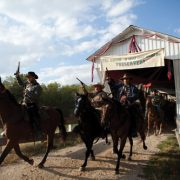
Civil War reenactors from throughout the Midwest portrayed Morgan’s Raiders during the creation of Conner Prairie’s new 1863 Civil War Journey: Raid on Indiana. © Conner Prairie
Affiliates invited to share 150th Civil War activities via Smithsonian social media

The General Locomotive at the Southern Museum of Civil War and Locomotive History (Kennesaw, GA). Photo © Southern Museum of Civil War & Locomotive History.

In April 1862, as train passengers and crews were eating breakfast in Big Shanty (modern Kennesaw, Georgia), a band of Union Civil War spies led by James J. Andrews stole the General locomotive from under the watchful eyes of guards at nearby Confederate Camp McDonald. Destroying telegraph wires and uprooting tracks in their escape north, the raiders would leave a path of destruction to the Western & Atlantic Railroad through the North Georgia Mountains. Conductor William Fuller and Confederates pursued “Andrews Raiders” using three different locomotives and caught them outside Chattanooga, Tennessee. Today, visitors to the Southern Museum of Civil War and Locomotive History, a Smithsonian Affiliate in Kennesaw, Georgia, can follow in the daring footsteps of William Fuller as he chases “Andrews Raiders” through the mountains, see the General locomotive itself, and participate in upcoming commemorative events.  

https://www.civilwar150.si.edu/

Smithsonian Affiliates across the U.S. are hosting events, exhibitions and highlighting artifacts like the General locomotive in Kennesaw, GA, throughout the 150th Anniversary of the Civil War. We’re inviting all Affiliates to promote their artifacts, blog, online exhibitions, upcoming exhibitions, events and anything related to the Civil War 150th anniversary so they can be highlighted on the Smithsonian Civil War 150 Facebook page and the Affiliate museum listed on the Smithsonian’s Civil War 150 website. 


To have your Affiliate highlighted:

  • Submit your events, exhibitions, blog posts, and artifacts to Elizabeth Bugbee
  • Send your own Facebook and Twitter info so we can “like” or “follow” your page
  • Send “This Day in Civil War History” stories from your community, highlight a Civil War expert from your neighborhood, talk about an artifact in your collection. the possibilities are limitless!
  • We’d love to go year-by-year, starting with 1861, but don’t let that stop you from submitting any information. We want to hear about anything Civil War-related at your organization!  

Smithsonian Affiliates are an important educational resource for visitors who are unable to travel to Washington, D.C., for commemorative events at the Smithsonian.  Let’s connect Civil War enthusiasts, historians, and fans of the Smithsonian to the resources available in Affiliate neighborhoods! 

Affiliates featured on the Smithsonian’s Civil War 150 website: (not listed? Email Elizabeth Bugbee)

Historic Arkansas Museum (Little Rock, AR)
Southern Museum of Civil War and Locomotive History (Kennesaw, GA)
Conner Prairie (Fishers, IN)
Baltimore & Ohio Railroad Museum (Baltimore, MD)
Lowell National Historical Park (Lowell, MA)
American Textile History Museum (Lowell, MA)
North Carolina Museum of History (Raleigh, NC)
National Underground Railroad Freedom Center (Cincinnati, OH)
Oklahoma Historical Society (Oklahoma City, OK)
National Museum of American Jewish History (Philadelphia, PA)
The National Civil War Museum (Harrisburg, PA)
The Senator John Heinz History Center (Pittsburgh, PA)
South Carolina State Museum (Columbia, SC)
American Civil War Center at Historic Tredegar (Richmond, VA)
Kenosha Public Museum (Kenosha, WI) 

Morgan's Raiders

Civil War reenactors from throughout the Midwest portrayed Morgan’s Raiders during the creation of Conner Prairie’s new "1863 Civil War Journey: Raid on Indiana."

Don’t forget to “like” the Smithsonian Civil War 150 Facebook page!

Smithsonian Artist Research Fellowship Program

The Smithsonian Artist Research Fellowship (SARF) offers visual artists the opportunity to spend between one and three months working among the vast collections of the Smithsonian Institution with experts on the Smithsonian staff. The fellowship offers a dynamic research environment in which to investigate the objects, discoveries, and historical events that inspire creative work rather than a studio. The program brings artists together with Smithsonian scholars from a variety of disciplines at museums and research centers in the United States and abroad to explore cross-disciplinary connections between history, art, culture, and science. SARF fellows are chosen by a panel of Smithsonian art experts with input from representatives from the Smithsonian history, culture, and science research communities. Fellowship terms are one to three months and must begin between June 1, 2012 and March 1, 2013. 

The program seeks to recognize outstanding established, mid-career and emerging artists with a demonstrated record of accomplishment. Artists should have a strong exhibition history; experience with public projects or commissions is desirable. Undergraduate students and MFA candidates are not eligible. The fellowship is open to U.S. citizens and foreign nationals. Successful applications will make a strong case for research projects that utilize Smithsonian-specific collections and resources. 

Candidates are nominated by Smithsonian curators of contemporary art and research staff; outside nominators representing international curators and scholars; and former and current Smithsonian Artist Research Fellows. Artists who are nominated and asked to submit an application are strongly encouraged to communicate with Smithsonian staff whose research relates to their project interests before applying to confirm the feasibility of projects.  A research staff directory is available online in the publication Smithsonian Opportunities for Research and Study, at www.si.edu/research+study .  A complete list of Smithsonian museums and research centers may be found online at: www.si.edu/museums  and www.si.edu/research .   

Nominators should consider the following in making nominations:  the quality of the artist’s work; his or her record of career accomplishments; and the feasibility and potential significance of the research proposal. 

Nominations must be submitted no later than September 15, 2011
Application Deadline: November 15, 2011
Notification of Decisions: by March 15, 2012

For questions, application guidelines, or to request a nomination form, please contact Pamela Veenbaas at veenbaasp@si.edu  or 202-633-7070.

SITES’ corner

By Ed Liskey, Senior Scheduling & Exhibitor Relations Coordinator, Smithsonian Institution Traveling Exhibition Service

We’d like to share some of the great experiences Affiliate museums have had hosting SITES exhibitions this past summer.  When will you get your SITES on?  

Native Words, Native Warriors at the Wisconsin Maritime Museum

The Wisconsin Maritime Museum (Manitowoc, WI) is hosting SITES’ Native Words, Native Warriors, from July 23- October 2, 2011. It’s the remarkable story of Indian soldiers from more than a dozen tribes who used their Native languages in the service of the U.S. military.

Museum Educator Wendy Lutzke reports that the museum has made  interesting historical connections between the exhibition and its World War II submarine, the USS Cobia.  The Cobia is the largest artifact in the museum’s collection, and is moored right outside the gallery.  “While researching the history of the Code Talkers in the Pacific, intern Nick Oswald found that both the Code Talkers and the crew of the USS Cobia had a direct impact on the outcome of the battle of Iwo Jima.  Code Talkers revealed deceptive Japanese communications that mimicked those sent by the Allies, while the crew of the USS Cobia destroyed two Japanese vessels, one of which was carrying tanks intended for Iwo Jima.” 

Native Words, Native Warriors at the Wisconsin Maritime Museum

In September, the museum will feature Oneida Nation historian Loretta Metoxen, to speak on the Oneida’s contribution to the Code Talker Program.  A medal recognizing the Oneida individuals involved in the program will be struck by the U.S. Mint later this fall. 

The Charlotte Museum of History (Charlotte, NC) hosted SITES’ Becoming American:  Teenagers & Immigration exhibition April 23 – July 17, 2011, and visitors loved every minute of it.  Photographer Barbara Beirne’s images capture first-generation immigrants and children of immigrants, revealing a diverse array of teenage responses to the immigrant experience.

Becoming American installation at The Charlotte Museum of History

 Exhibits Manager Lee Goodan reported that “the Museum actively works to engage the diverse community of the Charlotte/Mecklenburg region, home to many immigrants from other areas of the world and transplants from around the country. The stories of Becoming American reflect the diverse make-up of the area, and provide compelling examples of finding identity with migration. As we explore the theme of home within our institution, this exhibition illustrated the challenges and opportunities of finding and remembering ‘home.’ The focus on teenagers provided us the opportunity to create a successful program for high school students. Based on visitor feedback, the content resonated with our visitors who identified with the stories or found the exhibition insightful on a topic with which they were not personally familiar.”

Becoming American high school program at The Charlotte Museum of History

 Ms. Goodan continued:  “It was an excellent exhibition- compelling, thought-provoking, and directly presented. The primary strength of the exhibition was that it seemed to be very effective at evoking responses- either intellectual or emotional- from visitors. Based on comments left in the exhibition response book, we received more comments of a personal or substantive nature than usual. Some included political or social commentary, some shared personal experience with immigration, and some simply noted that they had been touched or affected by the stories.”

Farmers, Warriors, Builders a the South Florida Museum

The South Florida Museum and Parker Manatee Aquarium (Bradenton, FL) is currently hosting Farmers, Warriors, Builders:  The Hidden Life of Ants, on view through October 9, 2011.  More than 140 guests got buggy with entomology family fun on Saturday, August 6 at a “Family Night” program at the museum.  Hands-on crafts, a cartoon movie about the critters, and a scavenger hunt through the museum including the Farmers, Warriors, Builders exhibition all made the event a huge hit.

The museum team is thrilled about another exhibition-related event with Dr. Mark Moffett, the world-renowned ant expert, award-winning photographer, and Smithsonian Research Associate whose work is featured in the exhibition.  On September 29, he will present “Adventures Among Ants: A Global Safari with a Cast of Trillions” based on his newest book of the same title. “We are thrilled to bring such a witty, experienced, renowned scientist and real-life adventurer to our community,” said Brynne Anne Besio, Executive Director. “This fascinating exhibition and the chance to meet Dr. Moffett represent such a unique opportunity for our members and the general public to learn from a modern-day explorer.”

Please visit our website to learn more about all of our exhibitions that will help you get your SITES on.

The Affiliate flag in the Becoming American installation at the Charlotte Museum of History


coming up in affiliateland in september 2011

Fall is underway in Affiliateland!

ARIZONA:
The Challenger Space Center opens the National Air & Space Museum’s In Plane View: Abstractions of Flight in Peoria, 9/2.

PENNSYLVANIA:
Senator John Heinz History Center displays four artifacts from the National Museum of American History in its Stars & Stripes: An American Story exhibition in Pittsburgh, 9/10.

TEXAS:
Bill Fitzhugh, archeologist from the National Museum of Natural History, will give a public lecture on Genghis Khan at the Irving Arts Center in Irving, 9/10.

FLORIDA:
The National Museum of Natural History’s Dr. Valerie Paul gives a talk at the Museum of Arts & Sciences in Daytona Beach, 9/10.

The South Florida Museum, Tampa Bay History Center, and the Frost Art Museum will be represented at the Florida Association of Museums for an Affiliations Session in Sarasota, 9/20.

The Museum of Arts & Sciences will host the Smithsonian Jazz Masterworks Orchestra in Daytona Beach, 9/23.

CALIFORNIA:
The Riverside Metropolitan Museum will host Smithsonian Citizen Science Week in Riverside, 9/20.

NATIONWIDE:
More than 80 Affiliates take part in Smithsonian Magazine’s Museum Day, 9/24.


kudos affiliates! september 2011

Affiliates have been busy in September!  Kudos to all.

The Arab American National Museum (Dearborn, MI) raised $285,887, with $150,000, from the Museums for America grant program. The funds will benefit the museum’s Understanding Arabs, Arab-Americans and Islam initiative, which aims to educate students throughout the Midwest. The museum also has been awarded a $150,000 grant by the American Association of Museums (AAM) for a project titled Watch Your Waste. The grant enables the Museum to partner with the Children’s Museum Jordan in Amman, Jordan, to create an e-museum where children from both countries will simultaneously conduct research about the garbage their families generate and dispose of.

Seven other Affiliates received Museums for America grants from the Institute of Museum and Library Services:

Michigan State University Museum (East Lansing, Michigan) will receive nearly $150,000 to complete chemical testing for natural science specimens and to make database and technological enhancements for its natural science and cultural collections.

 USS Constitution Museum Foundation(Charlestown, Massachusetts) will received $149,023 for a hands-on, Old Ironsides 1812 Discovery Center gallery and programs, grounded in research and designed for all ages, to learn about the USS Constitution and the War of 1812.

National Civil War Museum (Harrisburg, Pennsylvania) will receive $138,600 to fund The Civil War 150 Years Later–Bringing History Back for the Future, a primarily Web-based project that is intended to enhance educational resources available to teachers, students, and the public on the Civil War.

Senator John Heinz History Center (Pittsburgh, Pennsylvania) will receive $112,760 to design, create, and coordinate travel for a 500-square-foot exhibition about the role of western Pennsylvania in the Civil War. 

Chabot Space and Science Center (Oakland, California) will receive $149,963 to implement the design phase of its upcoming outdoor exhibit, Launchpad. Through Launchpad, students and visitors will learn about space and the sciences as they play and engage in hands-on activities throughout the exhibit.

Conner Prairie (Fishers, Indiana) will receive $141,885 to develop and implement Test Lab: Indiana Inventions, a 500-square-foot exhibit focusing on the themes of energy, innovation and invention; life sciences; and environment and nature; that will place visitors in the role of a scientific investigator. 

Hubbard Museum of the American West (Ruidoso Downs, New Mexico) will receive $79,355 to upgrade and add technology to its new distance learning center to provide new opportunities to learn about the history and culture of the southwest for adults, families, and pre-K through grade 12 students.

 Two other Affiliates received funding for the 2011 Museums & Community Collaborations Abroad (MCCA) program by the American Association of Museums and the U.S. Department of State’s Bureau of Educational and Cultural Affairs:

Atomic Testing Museum (Las Vegas, Nevada) will partner with the Karaganda Ecological Museum (Karaganda, Kazakhstan) to develop Nuclear Weapons Testing Legacy: The Tale of Two Cultures. Students in both cities will collect oral histories and radiation data from the areas surrounding the Nevada and Semipalatinsk test sites. Ultimately, participants will produce a joint report and conduct symposiums with experts in each country to explore the local and international implications of their findings.

California Science Center (Los Angeles, California) will work with Maloka (Bogota, Colombia) to create Rainforest Leadership Academy: Cross-Cultural Teacher Training and Mentoring.  To empower teachers with the resources, skills, knowledge, and the confidence to deliver inquiry-based science lessons to their classes, the California Science Center and Maloka will enlist mentor teachers from local public schools to collaboratively develop materials for teacher professional-development trainings and student activities.

The African American Museum in Philadelphia(Philadelphia, Pennsylvania) was awarded $149,287  as part of the Museum Grant for African American History and Culture by The Institute of Museum and Library Services (IMLS).  AAMP will create resources for smaller museums through a project that trains future African American museum professionals.

Three affiliates received grants from The National Endowment for the Humanities to support ongoing projects.

Montana Historical Society (Helena, Montana) received $290,000 to digitize over 100,000 pages of Montana’s microfilmed newspapers, dating from 1864 to 1922, as part of the National Digital Newspaper Program (NDNP).

Center for Jewish History (New York, New York) will receive $103,657 to support the digitization of approximately 1,000 volumes to add to the Wissenschaft des Judentums library, which was dispersed and partially destroyed during World War II.

Oklahoma Historical Society (Oklahoma City, Oklahoma) was awarded $325,000 to support the digitization of 100,000 pages of Oklahoma newspapers dating from 1836 to 1922, as part of the National Digital Newspaper Program (NDNP).

 JP Morgan Chase & Co. is donating $1 million to the Perot Museum of Nature & Science (Dallas, Texas) to support the Bio Lab and related educational programming in the Being Human Hall, which will be part of the new museum under construction.

Annmarie Sculpture Garden & Arts Center (Dowell, Maryland), received a $12,000 grant from The Dominion Foundation’s to give more than 60 teens an opportunity to participate in center’s summer arts program.

The Museum of History & Industry (Seattle, Washington) has received a gift of $10 million from Jeff Bezos, the founder and chief executive officer of Seattle-based Amazon.com. The grant will be used to establish the Center for Innovation at the new MOHAI opening in late fall of 2012.