Affiliates collaborate with AAM to offer webinar

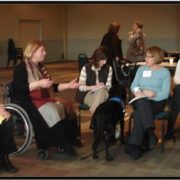
Beth Ziebarth, Director of the Smithsonian Accessibility Program, discusses Universal Design principles with museum peers.
The museum profession is well-acquainted with requirements in the Americans with Disabilities Act – for ramps, accessible restrooms, and other physical infrastructure needs – but how about for exhibitions and public programs?
This will be a topic of discussion in an upcoming webinar entitled Universal Design: Beyond the Americans with Disabilities Act on Wednesday, October 27. In a unique onsite-online learning model, Affiliations has teamed up with the American Association of Museums(AAM) to offer opportunites for museum professionals around the country to come together to experience the webinar. 25 Affiliates(in 21 states and Puerto Rico) will serve as “host sites”for their peers to network, watch the webinar together, and engage in moderated discussions about the specific implications of universal design for their museums and communities.
“Planning a program using a universal design perspective is different from designing a program for the deaf, for example,” says Beth Ziebarth, Director of the Smithsonian’s Accessibility Program, and main webinar presenter. Most simply, universal design is human-centered design, a user-friendly approach to the design of environments that are accessible to people of any culture, age, size, weight, race, gender and ability. Designing with such an approach is not only beneficial for people with disabilities, but for multi-generational families, pregnant women, the elderly and more. The webinar will explore integrating universal design into exhibitions and public programs; engaging your local disability community to inform program designs; and developing resources to share across a community’s cultural organizations.
We saw the power of this shared learning approach first-hand. In March 2009, Beth led a training seminar for cultural leaders in Pittsburgh at the Heinz History Center. About 60 professionals from the city’s museums, historical societies, theaters, operas, art galleries and more, spent a morning discussing their particular accessibility issues. By sharing successes and challenges, they were able to brainstorm collaborative and cost-saving possibilities for solutions – i.e., sharing the costs of an LED reader or mobile assistive-listening device, to make it more affordable for several organizations. Since then, the participants have created an accessibility task force that meets quarterly in an effort to make Pittsburgh’s cultural attractions even more accessible to everyone.
AAM is the perfect partner to help take the Pittsburgh example to a national scale. Their popular, high-quality professional development webinar series reaches thousands of museum professionals each year. Together, we can deliver Smithsonian expertise to a broad audience of museum peers and disability advocates throughout the country. We are all very grateful to the Smithsonian Women’s Committee for funding this collaboration experiment.
So head to your local Affiliate this fall and join the conversation!
Affiliate host sites:
Birmingham Civil Rights Institute, Birmingham, AL
Arizona State Museum, Tuscon, AZ
San Diego Air & Space Museum, San Diego, CA
Riverside Metropolitan Museum, Riverside, CA
History Colorado, Denver, CO
Frost Art Museum, Miami, FL
Orange County Regional History Center, Orlando, FL
Georgia Aquarium, Atlanta, GA
Conner Prairie, Fishers, IN
Frazier International History Museum, Louisville, KY
National World War II Museum, New Orleans, LA
Lowell National Historical Park, Lowell, MA
Reginald F. Lewis Museum, Baltimore, MD
North Carolina Museum of History, Raleigh, NC
Atomic Testing Museum, Las Vegas, NV
Yeshiva University Museum, New York, NY
Archives of the History of American Psychology, Akron, OH
Oklahoma Museum of History, Oklahoma City, OK
Senator John Heinz History Center, Pittsburgh, PA
Museo de Arte de Puerto Rico, San Juan, PR
Culture and Heritage Museums, Rock Hill, SC
The Women’s Museum, Dallas, TX
Institute of Texan Cultures, San Antonio, TX
Virginia Museum of Natural History, Martinsville, VA
Museum of History & Industry, Seattle, WA
There are two ways to register:
1) Contact affiliates@si.edu or visit the Affiliations website to get a list of contacts at each Affiliate host site. Register directly with them to attend at their site, and receive a discounted registration fee of $15.
2) Register directly through AAM and watch the webinar online, https://www.aam-us.org/getinvolved/learn/universaldesign.cfm
 As I crisscrossed the Mall and marched to Smithsonian sites beyond, I clutched my cell phone and lugged my laptop, always mobile and ready for my daily Smithsonian adventure. The Smithsonian is embracing mobile technologies as it strives to serve visitors in their museums and in cyberspace. My Visiting Professional residency provided me the contacts and time to learn about the ways the Smithsonian is engaging visitors through digital means as well as some more low-tech “human” engagements in their halls.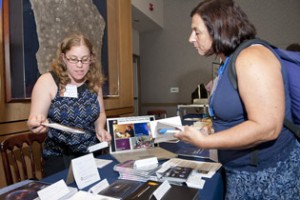
 The high point was talking with Xavier Carnegie, Actor and Trainer for museum theater programs. He spoke about the power of theater to emotionally involve visitors with the history and ideas behind museum objects. Observing him in two different on-floor drama presentations was powerful.
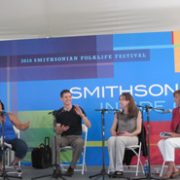
  On my last day, in honor of my explorations, I was invited to moderate a panel about digital media at the Smithsonian on one of the stages at the Folklife Festival. Smithsonian staff spoke about how their jobs had changed over time and how they were approaching making their resources available using digital media. The audience expressed interest in access to content and images and applauded their efforts.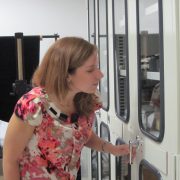
 We worked on one collection consisting of modern philatelic and postal history artifacts which are being transferred from the USPS to the National Postal Museum’s care. We re-housed, marked, and cataloged all of the objects during the first phase. Next, we created digital records for more than 4000 records down to the item level. Hard work, but we accomplished our task a month ahead of schedule! With the help of curators and conservation staff, we identified the items that would be the best candidates for imaging. Some of the artifacts in the collection were larger than the imaging equipment we had in-house, so we couriered these objects to a facility that would be able to handle our imaging needs. It was fascinating to courier the objects and to have access to some of the most state-of-the-art equipment in the field of image capture.
  Taking part in both of these projects has helped me understand the logistics behind coordinating loans and standards involved in collections’ imaging projects. I feel that much of the experience that I gained through this period will aid in the second portion of my internship at the Frost Art Museum. I look forward to contributing valuable knowledge to the digitization plan and efforts at the Frost.
 The Air Zoo (Portage, MI)
 National Museum of Nuclear Science & History (Albuquerque, NM)
 Frazier Museum of International History (Lexington, KY)
 Arizona Historical Society (Tucson, AZ)
 Snug Harbor Cultural Center (Staten Island, NY)
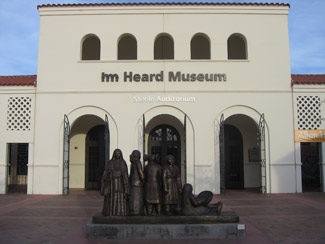 Heard Museum (Phoenix, AZ)
 Japanese American National Museum (Los Angeles, CA)