Native Film Festival Collaborations

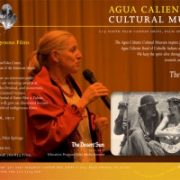
A postcard annoucing the event with Elizabeth Weatherford at the Agua Calinte Cultural Museum


Later this month, the Agua Caliente Cultural Museum (Palm Springs, CA) will host their annual Festival of Native Film & Culture in collaboration with the Film and Video Center at the National Museum of the American Indian (NMAI).  Elizabeth Weatherford, Director of the Film and Video Center at NMAI, works closely with Agua Caliente staff to identify exciting films and filmmakers working from a Native American perspective.  A highlight of this popular event is the commentary Elizabeth provides prior to screening the films and an engaging Q&A afterwards.  This year Elizabeth will give an illustrated lecture about the emerging world of indigenous films.

Michael Hammond, Executive Director at Agua Caliente, talks about the partnership:

“Elizabeth has been our guest programmer for several years now.  Our Festival of Native Film and Culture deals with Native American and Indigenous films from around the world.  Elizabeth has her finger on the pulse of the Native and Indigenous film world.  From cutting-edge shorts to feature films, she has given us the best that the genre has to offer.  Under her tutelage, we have grown in both quality and stature.”

The Native Eyes Film Festival at the Arizona State Museum/ Hanson Film Institute

Elizabeth has also worked with other Affiliates on film festivals; she continues to work with the Arizona State Museum and the Hanson Film Institute, both at the University of Arizona on an annual event, the Native Eyes Film Showcase.  Lisa Falk, Director of Education and Associate Curator at the Arizona State Museum, discussed the ways that Elizabeth Weatherford has worked with them:

“Elizabeth, her staff and the resources of the Film and Video Center are invaluable to us as they provide a depth of understanding of Native filmmaking and festival organization as well as connections to filmmakers.  We have worked with Elizabeth Weatherford and her staff on our Native Eyes Film Showcase for years- consulting with them about new films and filmmakers and receiving recommendations.  The NMAI Film and Video Center helps us add breadth and depth to our programming, in particular enabling us to learn about and include films from Canada, Australia, and New Zealand to our offerings.”

Let us know if you’re interested in a film series of your own- we can connect you with Elizabeth Weatherford at NMAI or other resources at the Smithsonian.  (Special thanks to Michael Hammond and Lisa Falk for images and insights!)
Exchange Boards: Post Your Exhibitions, Programs, Jobs Here

Are you looking for a job or have one to announce? Are you searching for a new exhibition or a program for your museum? Do you have an exhibition or a program you’d like to travel to other Affiliates? 

You may have forgotten that the Smithsonian Affiliations website is your one-stop-shop for these types of announcements. On our Exchange Boards you can post a job you’d like to fill, announce a new traveling exhibition, or promote a program that’s available to other Affiliate organizations.  

Further your reach by submitting your job, exhibition, or program announcements with us and we’ll not only post on our website, but also promote it across our new media platforms.

Exhibition Exchange
Emails requesting exhibition exchange postings must be submitted in the following format:
  • Complete Affiliate name, city, and state
  • Brief description of available exhibition (1 or 2 short sentences)
  • Contact information for anyone interested
  • Attached PDF or Word document including all the necessary information about the exhibit
  • Complete link to the traveling exhibit page (if not using PDF)

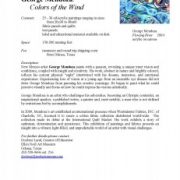
Example: George Mendoza: Colors of the Wind
Presented by the Ellen Noel Art Museum in Odessa, TX.
New Mexico artist George Mendoza paints with a passion, revealing a unique inner vision and confidence, coupled with insight and creativity. His work, abstract in nature and brightly colored reflects his current physical “sight” intertwined with his dreams, memories, and emotional experiences. The exhibition includes 25-30 oil/acrylic paintings ranging in sizes from 20×30 to 48×60; fabric panels and quilts; text panels; label and educational material available on disk. Affiliates who are interested in hosting the exhibition should contact Doylene Land at doylene@noelartmuseum.org.

Program Exchange
Emails requesting exhibition exchange postings must be submitted in the following format:

  • Complete Affiliate name, city, and state abbreviation
  • Description and details of the program (including cost and available dates)
  • Attached PDF or Word document including all necessary information about the program

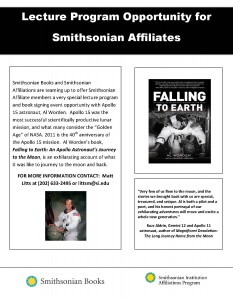
Example: Falling to Earth: An Apollo Astronaut’s Journey to the Moon lecture and book signing event opportunity with Apollo 15 astronaut, Al Worden.

Jobs Exchange
Job announcements must be submitted as a separate attachment (Word document or PDF) including:

  • Complete Affiliate name (and logo if possible)
  • Job title
  • Full job description
  • Deadlines
  • Contact information

Example: Flushing Town Hall

For more information, or to post an announcement, contact Elizabeth Bugbee.


water matters


Join the Smithsonian Center for Education and Museum Studies for FREE online webinars around the theme of water.  These are great events to share with  your local teachers, educators and students. 

In February, March, and May, the Smithsonian will look at water, the most essential of subjects, from many points of view, from marine biology to American history. Explore both water quality (how we can ensure that water is safe for ourselves and for the environment) and water quantity (how we can manage crises of too much water and not enough water).

We invite you to take part with your K-12 class, or on your own as professional development. The Shout program addresses curriculum standards for ecological, social, and economic systems; human impact on the environment; and civic responsibility.

Free registration is now open. 

Here’s some details to “wet”  your appetite for learning!

Teacher Preview Session
January 19, 2012, 3pm EST 

Get ready to make the most of the Shout: “Water Matters” program by signing up now for the teacher preview session on Thursday, January 19, 2012 at 3 pm ET. If you cannot participate live, a recording will be made available following the live event for your enjoyment at any time.   You’ll learn about Smithsonian classroom resources, interact with other teachers who are also incorporating the SHOUT program into their curriculum, and discover how to stay connected through various social media sites. This online preview will allow you to plan ahead for the upcoming conference sessions and will be a forum for discussion of incorporating global environmental issues into the classroom.

Water Questions: When We Want to Learn More
February 7-8, 2012

For the full program for February 7-8, visit: https://www.smithsonianconference.org/shout/program-2012/

Topics to be Covered include:

Planet Water
What kinds of human interventions can help the health of marine life?

It’s Not Easy Being Amphibian: The Importance of Water
How does water quality and quantity relate to conserving amphibians in captivity and the wild?

Listening to the Water Nations
How do Indigenous peoples perceive and respond to water issues?

A Look Back at Music as an Environmental Advocacy Approach
How can music build awareness of environmental issues?

Looking at Global Water Resources from Space
What can orbiting satellites tell us about Earth’s greatest resource?

The Nitrogen Problem: Causes and Remedies
How can our actions affect coastal waters and the cycle of an essential element?

Sink or Float: Water and Design Solutions
How does design solve problems of individuals and communities around the world in sustainable ways?


Stay Connected:
Twitter: twitter.com/shoutlearning
Facebook: facebook.com/shoutlearning

This event is part of Shout, a collaboration between the Smithsonian Institution, Microsoft Partners in Learning, and TakingITGlobal. More at www.shoutlearning.org.
SEE YOU THERE!

Mastodon Menagerie

Special thanks for this guest post to James “Zach” Zacharias, Senior Curator of Education and Curator of History at The Museum of Arts and Sciences, a Smithsonian Affiliate in Daytona Beach, Florida. 

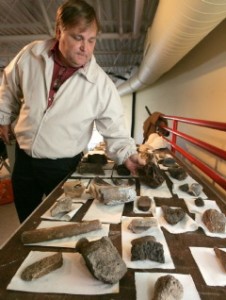
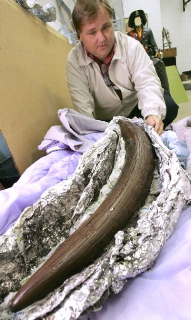
James "Zach" Zacharias, Senior Curator of Education at the Museum of Arts and Sciences, with one of the tusks from an adult mastodon. Photo courtesy of The Museum of Arts and Sciences.

The Monday morning before Thanksgiving 2011 seemed like any other day at the Museum of Arts & Sciences (MOAS) until the City of Daytona Beach emailed me a picture of what appeared to be a large lower jawbone. The City had been excavating a drainage pond two miles north of the Museum and workers found massive and mysterious bones. Upon closer inspection of the image, it became clear to me that I was looking at the lower mandible and teeth of an American Mastodon. 

The City promptly postponed construction so MOAS could dispatch personnel to the site. Although I was in a shirt and tie, I jumped into the mud- and muck-filled pit for a closer look! Within five minutes, I located a partially exposed tusk protruding from the pond’s north wall. As I investigated the layers of earth, I knew right there and then this was the tusk of an Ice Age mammoth or mastodon. It dawned on me this was turning into an incredible prehistoric discovery for our area. With hopes of unearthing the full skeleton, we set to work. 

An army of Museum staff and associates quickly converged on the site to help in the excavation effort. With painstaking care and effort, two delicate partial tusks were removed. These precious pieces of the Pleistocene were each placed in a “plaster jacket” (a protective covering used by paleontologists to move fossil specimens from the field) and moved to their secure home at the Museum. 

Assorted museum staff and volunteers at the construction site at the bottom of the drainage pond being excavated. Photo courtesy of The Museum of Arts and Sciences.

The rest of the excavation soon turned into a salvage operation. Unbeknownst to the workers, a portion of the skeleton (other than tusks) which was interspersed amongst the rocks and stones had been routinely put through a giant rock screener. This broke up some parts of the skeletal remains. As MOAS representatives sifted through the debris piles, a plethora of broken vertebra, ribs, limbs and skull bones were found. Currently, MOAS is cleaning, sorting and accessioning the fossils. A portion of the femur is currently being prepared for carbon dating by the Smithsonian National Museum of Natural History.  

A construction worker found this lower mandible of the American Mastodon. Photo courtesy of The Museum of Arts and Sciences.

This is the second significant paleontological find for the Museum of Arts & Sciences – the first being the 1975 discovery of the remains of 13 giant ground sloths in a barrow pit near Nova and Reed Canal roads. MOAS proudly displays the most complete and best preserved giant ground sloth skeleton in the world.  

Florida’s peninsula has submerged and re-emerged numerous times as the earth has passed through ice ages and warming trends. The paleontology of Florida demonstrates there were no dinosaurs here (the state was underwater during the Mesozoic Era) and this is reflected in the abundant marine fossils found in Central Florida. The animal fossils found here belong to “mega-fauna” mammals such as the giant ground sloth, mastodons and mammoths, saber cats, dire wolfs, paleo llamas, and the glyptodon. They roamed our landscape from 130,000 to 10,000 years ago.  

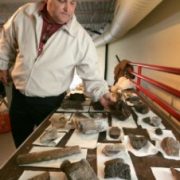
James "Zach" Zacharias with the assorted bone fragments from the mastodon. Photo courtesy of The Museum of Arts and Sciences.

The discovery of the Daytona Beach American Mastodon is thrilling and exciting for the Museum, the City and our community. MOAS is looking forward to adding the fossils to an exhibit for all to see –encouraging inspiration, curiosity, and the love of knowledge.

coming up in affiliateland – december 2011 and january 2012

a busy ending to 2011… and full steam ahead into 2012!  

TEXAS:
The
Frontiers of Flight Museum hosts the the National Air and Space Museum’s At the Controls in Dallas, 12/1.

GEORGIA:
The
Southern Museum of Civil War & Locomotive History celebrated its 10th anniversary as a Smithsonian Affiliate in Kennesaw, 12/3.

COLORADO:
The
Littleton Museum hosts SITES’ 125 Years of Lasting Light: Grand Canyon Photography in Littleton, 12/8.

TENNESSEE:
The
American Museum of Science and Energy hosts SITES’ Earth From Space in Oak Ridge, 12/16.

FLORIDA:
The
Mennello Museum of Art will host SITES’ William H. Johnson: An American Modern in Orlando, 1/6.

MISSISSIPPI:
The Smithsonian Early Enrichment Center will present a professional development workshop at the
Ohr-O’Keefe Museum of Art in Biloxi, 1/12.

FLORIDA:
The
Orange County Regional History Center will host SITES’ Beyond Baseball: Roberto Clemente in Orlando, 1/21.

WASHINGTON, D.C.:
Plimoth Plantation (Plymouth, MA), Birmingham Civil Rights Institute (Birmingham, AL), National Museum of American Jewish History (Philadelphia, PA), Arab American National Museum (Dearborn, MI), Japanese American National Museum (Los Angeles, CA), Senator John Heinz History Center (Pittsburgh, PA), Institute of Texan Cultures (San Antonio, TX), and the Western Reserve Historical Society (Cleveland, OH) will participate in a two day meeting to brainstorm ways in which the institutions could work together to foster civic engagement on immigration/migration issues, 1/25-1/26.

WASHINGTON, D.C.:
The
Rubin Museum of Art (New York, NY), the Museum of Nature and Science (Dallas, TX), Miami Science Center (Miami, FL), and the California Science Center (Los Angeles, CA)  will participate in planning meeting for a National Symposium on Early Learning, 1/27-28.

CALIFORNIA:
The
Columbia Memorial Space Center will host SITES’ Suited for Space in Downey, 1/28.


First Look: SITES’ Evolving Universe

Our Sun is only one of 100 billion stars in our galaxy. Without it, life on Earth would not be possible. What we know about our Sun serves as the foundation for what we understand about distant stars. Credit: NASA/Lockheed Martin/SAO.

Special thanks to Ed Liskey, Senior Scheduling & Exhibitor Relations Coordinator, Smithsonian Institution Traveling Exhibition Service, for this guest post.

The Smithsonian Institution Traveling Exhibition Service (SITES) is pleased to offer Smithsonian Affiliates an early opportunity to be among the first venues to host the new The Evolving Universe traveling exhibition.  The Evolving Universe will feature 27 full-color, oversize images that will explore what we know about the history and structure of our solar system, the Milky Way and other galaxies and the universe as a whole. 

Two bright pinpoints of light in NGC 6240 show two supermassive black holes merging in the galaxy’s center. The black holes are only 3,000 light years apart and have been spiraling toward each other for about 30 million years. Credit: NASA/CXC/MIT, NASA/STScI.


Through these stunning photographs and engaging text, visitors will travel back in time and space to the beginnings of our universe.  With specialized content targeting both the young and curious as well as more technically-savvy visitors, The Evolving Universe will have wide appeal.  Act now to host this exciting exhibition of the latest cosmological knowledge and the amazing technologies scientists use to attain that knowledge.  Learn more and see additional exhibition images on SITES’ The Evolving Universe website.


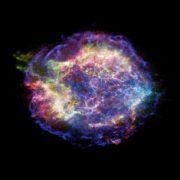
During the supergiant and supernova phases of star death, nuclear reactions fuse helium and carbon into heavier elements, such as silicon (seen in green in this image) and iron (red). These elements are ejected forcibly in clouds that are light-years in diameter, seeding the next generation of star formation with the elements that make up planets like Earth. Credit: NASA/CXC/MIT/UMass-Amherst.