

Smithsonian Affiliate staff member helps in Haiti recovery project
Special thanks to Beverly N. Perkins, conservator at Buffalo Bill Historical Center in Cody, Wyoming, for this guest post.
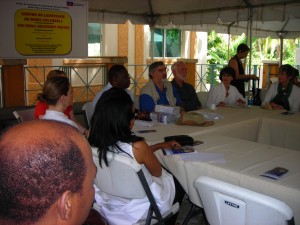
AIC-CERT members, Smithsonian Secretary G. Wayne Clough and Under Secretary for History, Art and Culture, Richard Kurin, the President's Committee on the Arts and Humanities, and CRCH members meeting to discuss recovery projects. Photo by Beverly Perkins.
Three American Institute for Conservation-Collections Emergency Response Team (AIC-CERT) members were asked to join the Smithsonian Haiti Cultural Recovery Project on July 4th, 2010. Beverly Perkins, Karen Pavelka, and David Goist spent some time with the staff of the Centre de Sauvetage de Biens Culturels(CRCH) helping to set up the CRCH labs so that they can be used for conservation treatments and to train Haitians in the recovery of cultural collections. Under the supervision of Project Manager, Stephanie Hornbeck, the visiting conservators also carried out conservation projects and helped to guide tours of the labs.
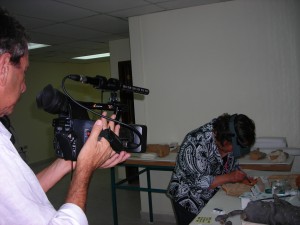
Conservation projects at work in the lab. Photo by Beverly Perkins.
A project I worked on involved conserving ceramics and building elements as they began to come in to the lab from various sites in Haiti. Some of the ceramics had been clumsily reassembled at some point in their past, prior to being brought to the conservation center. One group ceramics from a nativity scene were considered to be more decorative than historical, and so the losses were filled and shaped to replicate the pieces that had been lost. These new elements were then toned with paints to make the ceramic appear to be whole again. All of the treatments are documented with written notes and photographs so that in the future our work may be easily distinguished from the original ceramic.
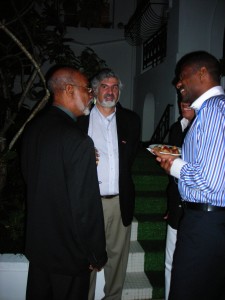
Richard Kurin and guests at a reception at the President and Mrs. Preval's home. Photo by Beverly Perkins.
Also during our stay, the United States President’s Committee for the Arts and Humanities visited Haiti, along with dignitaries from the Smithsonian and The Broadway League. The meetings held with Haitian cultural leaders helped to strengthen the determination to salvage cultural collections and train Haitians in that salvage effort. The visiting dignitaries, AIC-CERT volunteers, and the staff of the CRCH were treated to an evening of Haitian song and dance at President and Mrs. Preval’s lovely home.
The ten days I spent away from the Buffalo Bill Historical Center, a Smithsonian Affiliate, were donated in the spirit of good will from the Museum’s board and staff and the people of Cody, Wyoming to the people of Haiti. Upon my return from Haiti, the Museum’s director, Bruce Eldredge asked how we could further be of assistance to the people of Haiti. He developed a plan to offer training for one or two Haitians in the conservation laboratory of the Buffalo Bill Historical Center. He further offered to provide support following those months of training.
This project is in the process of being formed, and so the story continues…

Devastation to a cathedral in Haiti. Photo by Beverly Perkins.


 Q&A: National Jazz Museum Director on the Newly Discovered Trove of Jazz Greats- The director of the National Jazz Museum in Harlem discusses new music by Count Basie, Lester Young, and others. READ MORE
 Several nonprofit organizations, a state agency and three local counties have been awarded $3.3 million from a state land preservation fund to protect 753 acres on the Big Island, Kauai, Molokai and Oahu. READ MORE. and MORE
 Students, researchers and the general public soon will be able to experience the history of psychology in a museum setting at The University of Akron’s (UA) new Center for the History of Psychology (CHP), which opens to the public Aug. 30. READ MORE
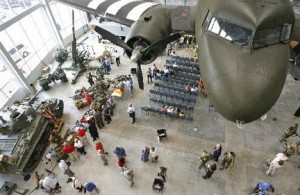 Construction of the $35 million U.S. Freedom Pavilion: Land, Sea and Air will be formally announced Friday as part of the museum’s overall $300 million expansion. READ MORE


 As I crisscrossed the Mall and marched to Smithsonian sites beyond, I clutched my cell phone and lugged my laptop, always mobile and ready for my daily Smithsonian adventure. The Smithsonian is embracing mobile technologies as it strives to serve visitors in their museums and in cyberspace. My Visiting Professional residency provided me the contacts and time to learn about the ways the Smithsonian is engaging visitors through digital means as well as some more low-tech “human” engagements in their halls.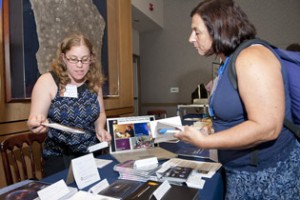
 The high point was talking with Xavier Carnegie, Actor and Trainer for museum theater programs. He spoke about the power of theater to emotionally involve visitors with the history and ideas behind museum objects. Observing him in two different on-floor drama presentations was powerful.
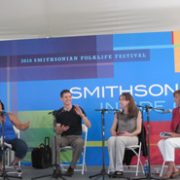
  On my last day, in honor of my explorations, I was invited to moderate a panel about digital media at the Smithsonian on one of the stages at the Folklife Festival. Smithsonian staff spoke about how their jobs had changed over time and how they were approaching making their resources available using digital media. The audience expressed interest in access to content and images and applauded their efforts.