Masterpiece on the Move


A masterpiece by one of America’s most renowned 19th-century landscape artists will soon make its way west from the Smithsonian American Art Museum in Washington, D.C., to the Buffalo Bill Historical Center in Cody, the only Smithsonian Affiliate in Wyoming.

Thomas Moran’s The Grand Canyon of the Yellowstone (1893 – 1901) will be on loan from the Smithsonian American Art Museum as part of the Whitney Gallery of Western Art’s 50th Anniversary celebration. The massive painting–more than eight feet high and fourteen feet long–arrives in early summer for a four-month stay and will be unveiled June 21.

“This is truly a glorious, iconic painting of Yellowstone that first appeared in Chicago at the 1893 Columbian Exposition,” says Alan Simpson, former U.S. Senator from Wyoming and the historical center’s chairman of the board of trustees. “What a rare and extraordinary privilege for our visitors to connect with Thomas ‘Yellowstone’ Moran’s Grand Canyon of the Yellowstone and then to see the landscape that inspired it as they travel in Yellowstone.”

Indeed, Moran (1837 – 1926) is often considered the pivotal figure in efforts to make Yellowstone a national park. In 1871, he accompanied F.V. Hayden’s geological survey of the area as guest artist and worked closely with photographer William H. Jackson. Ostensibly, Moran painted the extraordinary sights of Yellowstone, and Jackson’s images proved they existed–in case there was any question about Moran’s interpretation.

The renovated gallery opens June 21, 2009. Grand Canyon of the Yellowstone will be on view through October 31, 2009.  Follow the countdown toward the opening of the Whitney Gallery of Western Art by visiting the historical Web site at www.bbhc.org/wgwa.  For more images from the Smithsonian American Art Museum’s flickr stream, click here.


Congratulations Buffalo Bill Historical Center!


“An Open Smithsonian, all around”

An interesting blog post by Gunter Waibel of RLG Programs, (a group which supports research institutions in collaboratively designing the future) commenting on the Smithsonian’s hot topic – how to “diffuse knowledge” in the 21st century with the creation of a web and new media strategic plan: 

As part of the process for arriving at the Smithsonian’s Web and New Media strategic plan, Michael Edson created a Wiki on which Smithsonian staff discuss their points of view in plain site of anybody who is interested in listening in. This experiment in radical transparency is in and of itself noteworthy, and so is the content which surfaces on the Wiki. Encouraged by @mpedson’s tweet, I particularly took note of two short talks arguing in favor of open access to museum content. The first paper (titled “Publish Everything!”) is by Betsy Broun (Director, Smithsonian American Art Museum); the second paper (titled “Make Content Freely Available”) is by Lauryn Guttenplan (Associate General Counsel at the Smithsonian). Both papers were presented as part of the Smithsonian 2.0 Forum on April 21, 2009. One reason why I found these notes remarkable is because those who are speaking represent the class of professional who oftentimes is perceived to be scuttling plans for making data more openly available – not in this instance!

Here are the outtakes I would have marked yellow if I had actually printed the pieces instead of saving a tree and reading online.

Publish Everything! – Betsy Broun (Director, Smithsonian American Art Museum)

I’m here today to advocate for publishing everything online. To the extent allowable by law, the Smithsonian should digitize and post online all our images and data, as well as the ideas and speculations that have accumulated in our files. We should let users help us sort and correct the information, and comment as they wish, from their own perspective.

What every expert knows [. ] is that knowledge is always advancing but never wholly correct. What we publish is the latest current knowledge, but tomorrow will dawn, with incriminating evidence that some of what we posted yesterday already is wrong.

[D]espite [our] good work, each year we actually lose ground, as many times more data and information is constantly coming in to our files, to remain buried there.

Why not push everything in our files online, including old outdated information and new information that hasn’t yet been validated? We’ll never have the perfect expert in every subject, but somewhere out there, that expert exists.

Bran Ferren argues that raw data is alive in all its imperfections, inviting testing and response. Authenticated data, by contrast, is more or less inert and monolithic. It commands respect but invites little interaction or questioning.

Make Content Freely Available – Lauryn Guttenplan (Associate General Counsel at the Smithsonian)

Position: We are a public entity and non-profit and we should make our content freely available to the extent we can.

It’s ironic, I think, that a lawyer – the one person most likely to tell you all the reasons you can’t give away content freely – is here to advocate this position, but my views on this issue have changed over the past 18 months [. ].

[The] Digital Media Use Working Group conducted a survey of SI staff. Over 600 of you responded and 91% agreed that digital assets should be available, and 84% said there should be unrestricted access for educational and non-commercial use.

[W]hat about the vast amounts of content that we can make available but choose to restrict because we want to use it exclusively or because a third party wants to use it for commercial purposes? In the survey, over 70% of you opposed making our content available for commercial purposes.

The Powerhouse Museum in Australia recently experimented with an open source initiative and, not only did they not lose licensing revenue, early statistics have shown that open access actually drove sales upward through awareness of the collection which, in turn, generated knowledge about other museum resources.

I have come to believe that control represents the world of Smithsonian 1.0 and if we want to keep up, remain relevant, fulfill our mission and even achieve greatness, we need to let go. So let’s control our destiny, as Secretary Clough said earlier, not our content.

I encourage you to explore the discussions on this Wiki, and follow the Smithsonian as they negotiate pressing issues facing not just museums, but cultural heritage institutions across the LAM spectrum.

Follow Gunter at hangingtogether.org
Affiliates at AAM

AAM logo

Affiliates provided alot of insight at the recent AAM meeting in Philadelphia.

Cassie Chinn, Deputy Executive Director of the Wing Luke Asian Museum in Seattle, presented in a session titled Community-Curated Exhibit Programs.  She described how the process of incorporating the community into every exhibition process is time-consuming and complicated, but that the Museum has made that conscious and ultimately rewarding decision to focus its entire operation toward community engagement and empowerment.  Wing Luke has lots of information about organizing their process, which you can find here.  As a testament to their leadership in this area, the Wing Luke was mentioned at other community-curation sessions as a model example of how to do it right. 

Ken Bubp, Chief Operating Officer at Conner Prairie talked about the historical site’s transformation in the face of declining attendance when they decided to overhaul their approach to the visitor experience.  He, and the others on the panel entitled, Achieving Impact: Intentionally or by Chance, described the difficulties and rewards of facing down staff entrenchment and ultimately challenging and empowering staff to turn an organization around. 

Carrie Gustavson, Director of the Bisbee Mining and Historical Museum in Arizona spoke at a lively panel, Beyond the Gala: Quirky New Ways to Engage Donors.  She talked about taking donors into mining pits to find turquoise, and not underestimating the potential support of volunteers.  The point of many of the panelists’ comments was that donors will often go to lengths and do things a Museum might not expect – like traveling on dangerous research trips or not-so-glamourous digs.  So be adventuous!

And of course, the two Philadelphia Affiliates proved to be wonderful hosts to the whole AAM community.  The African American Museum hosted a panel about going green, and shared tips and advice from their current renovation and installation of “Audacious Freedom,” a new permanent exhibition about African Americans in the city between 1776-1876.  The National Museum of American Jewish History also shared a plethora of lessons learned in the construction of their new $150 million building on Independence Mall.  Among the expert advice: seize unexpected opportunities, even if it throws a project off the planned course in the process.

If you haven’t seen the video produced especially for the meeting by our museum colleagues in Philadelphia, it was wonderful.  Check it out on YouTube.

And you – what did you most take away from Philadelphia this year? 

Girl Scouts “Go the Distance” for a Merit Badge with Smithsonian American Art

Special thanks to Mike Irwin, Distance Learning Coordinator at the Durham Museum in Omaha, for this guest post.

 Girl Scouts meet the Smithsonian's American Art Museum in Omaha.

Group Programs Manager, Molly Gruber walked into the Distant Learning Coordinator’s office at the Durham Museum and asked, “Can we connect girl scouts with experts to talk about the security of rare and priceless art objects?”

Two months later on a chilly April morning there was a good bit of excitement as 74 Girl Scouts sat in The Durham Museum’s Stanley and Dorothy Truhlsen Lecture Hall waiting to be connected to the Smithsonian American Art Museum.  Most of the girls had never been in a distant learning video conference and really didn’t know what to expect.  With a click of the button, Sara Rouse and Susan Nichols appeared on a 25 ft screen in front of a backdrop of the outside entrance to the Smithsonian American Art Museum.  The girls, seeking some of the information that they needed to complete their merit badge in museum studies, were immediately at ease with this technology and engaged from the beginning.  In unison the girls shouted “hello” and the program was underway.  Susan introduced a great selection of slides showing very unique art pieces with background on the artist and format before security issues of each piece were discussed. 

When it came time for questions all was silent until one scout sheepishly raised her hand but when the microphone was passed to her she had forgotten her question.  She smiled and kept thinking.  The ice was broken and hands went up all over the lecture hall anxious to ask a question. The questions asked were thoughtful indicating that this group did, in fact, really pay attention. The girls were really impressed with being live and interactive and asked “when can we do this again!”

It was only natural to contact the Smithsonian’s American Art Museum to develop this video session. The Durham Museum, a Smithsonian Affiliate, had already collaborated with SAAM for two very successful distant learning programs, finding the staff responsive and willing to create or modify a current program to meet specific needs.    With a broad range of pre-packaged programs attaching national standards and the ability provide specific content, The Durham Museum certainly intends to use this valuable distance learning resource well into the future.  

On their way to a badge!

Alexander Calder sculpture

Cross Collection searching

calder.jpg 

Ever wish you could go to one place to search across the whole Smithsonian for objects?

We want that for you too! and we’re getting closer and closer. The Hirshhorn Museum and Sculpture Garden was just added to the Smithsonian’s Cross Searching Center, along with the great collections from the National Postal Museum, the National Portrait Gallery, and the Smithsonian American Art Museum. Our goal? Nothing short of a one-stop searching environment for SI collections!

For example: Check out this search on Alexander Calder.

In this search, we found objects from multiple SI units:
– Sculptures, paintings, drawings from American Art, Hirshhorn, and Portrait Gallery museums,
– Photographs from SI Archives, Juley Photo Archives and Archives of American Gardens,
– Interviews, sound recordings and letters from Archives of American Art,
– and Books from SI Libraries

We hope this makes it easier for the public to find what they need, and see more of what we have.  What do you think -useful?!  We’d love to hear about your searches and findings….

Collaborating in Pennsylvania

I just got back from a road trip to Pennsylvania, and what struck me with all the Affiliates I visited there was the various and creative ways they are all collaborating, with each other and with their greater communities.

In Hershey…

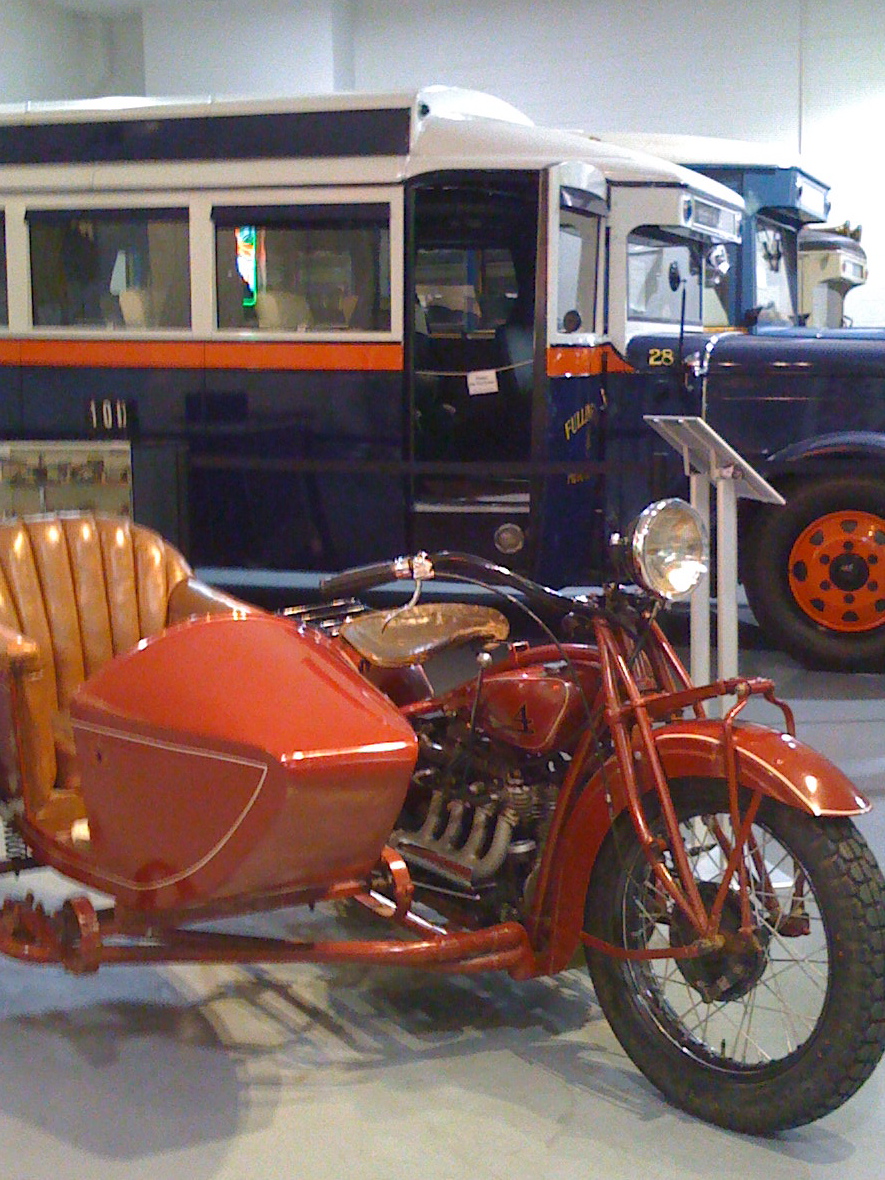
Motorcycles and buses at the Antique Automobile Museum of America Museum
 

The Antique Automobile Club of America Museum partnered a while ago with the Museum of Bus Transportation that occupies their lower floor.  The Bus Museum has the largest collection of historic buses under one roof in the United States, including the Lakeland Bus Lines bus from the movie “Forrest Gump”. Recently, they’ve also partnered with the Antique Motorcycle Club of America to provide gallery space for some pretty amazing vehicles, including a 19th century steam “motorcycle.” Different collections, common mission – what better idea than to partner to present various views on the history of transportation in America?

In Pittsburgh…

Betty Siegel, Director of Accessibility at the Kennedy Center, with Pittsburgh's performing arts community

At the Heinz History Center, 60 professionals from the cultural and performing arts organizations in Pittsburgh came together for a training on incorporating the lessons of universal design for the benefit of their visitors. The training itself was a collaboration – between the accessibility directors of the Smithsonian and the Kennedy Center. Not only was the discussion itself very informative and resource-rich, but the participants started discussing ways they could collaborate outside the session – theaters buying expensive LED readers together that they could share, or hiring audio descriptors to service several of their organizations’ exhibitions, so as to cut costs.

In Easton… the director of the National Canal Museum shared the various ways he’s working with nearby Historic Bethlehem Partnership.  For example, together they are meeting with officials in the state government to make a regional case for support instead of just an individual one, and brainstorming ways to attract incoming casino patrons (a Sands Casino opens in Bethlehem in June) to visit both museums to experience the bigger picture of the rich industrial heritage of the Lehigh Valley.

I may be looking too hard for silver lining in this economic crisis, but the ways that it is encouraging cultural organizations to come together in innovative ways gives me hope for the future – for these museums and the communities they continue to impact.