
new Undersecretary for Science

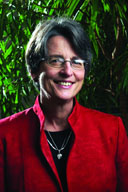
Dr. Eva J. Pell   


Dr. Eva J. Pell


Eva J. Pell, Senior Vice President for Research and Dean of the Graduate School at Pennsylvania State University, has been named Under Secretary for Science at the Smithsonian Institution. Pell has been Vice President and Dean since 2000 and was promoted to Senior Vice President for Research and Dean of the Graduate School at the university in 2006. She will begin at the Smithsonian Jan. 4, 2010, and report directly to Smithsonian Secretary Wayne Clough.

As Under Secretary for Science, Pell will directly oversee the operations of the National Museum of Natural History; the National Air and Space Museum; the National Zoo and its Conservation and Research Center in Front Royal, Va.; the Smithsonian Astrophysical Observatory in Cambridge, Mass.; the Smithsonian Environmental Research Center in Edgewater, Md.; the Smithsonian’s Museum Conservation Institute in Suitland, Md.; and the Smithsonian Tropical Research Institute in Panama.

Pell, 61, brings an environmental science background to this position and a strong track record of leadership. She was a professor in the department of plant pathology at Penn State for more than 35 years. In her role as Senior Vice President for Research at the university, Pell spearheads the development of cross-disciplinary institutes for life sciences, materials, energy and environment, social sciences, cyber science, and arts and humanities; all six institutes report directly to her. She is also responsible for sponsored research, compliance and the university’s animal research center. In addition, Pell is responsible for the Penn State Research and Technology Transfer Organization, which connects Penn State researchers with industries in order to stimulate economic development.  

As Dean of the Graduate School, she oversees graduate admissions, fellowships, awards and curriculum. Pell has developed several programs at Penn State to increase the number of minority applicants for graduate programs.

Pell holds a bachelor’s degree in science from the City College of New York and a doctorate degree in plant biology from Rutgers University. Her research focuses on the effects of air pollution on plants.

Pell has served on panels and advisory boards for the Environmental Protection Agency, the Department of Agriculture and the Department of Commerce. She currently serves on the National Science Foundation’s Biological Sciences Advisory Committee. In addition, Pell is active in economic development and serves on a number of Pennsylvania state boards, including the Ben Franklin Center of Central and Northern Pennsylvania and the Life Sciences Greenhouse of Central Pennsylvania. She is also the president of the Penn State Research Foundation and the Research Park Management Corporation.

“We are proud to welcome Dr. Pell to the Smithsonian as our new Under Secretary for Science,” said Secretary Clough. “She is an accomplished scientist, experienced leader and inspired educator who will help us raise the global profile of Smithsonian science. We will benefit greatly from her many talents.”

“Anyone who comes to Washington, D.C., finds him or herself touched by Smithsonian activities, as the Institution is at the nexus between discovery and education,” said Pell. “I am excited and humbled by the opportunity presented to me by Secretary Clough and am looking forward to the possibilities to expand the reach and dimensions of Smithsonian science.” 
behind the scenes with african animals


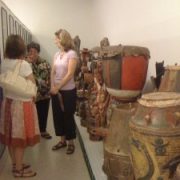
Annmarie Garden staff chat with curator Bryna Freyer in the storage area of the National Museum of African Art

Annmarie Garden staff chat with curator Bryna Freyer in the storage area of the National Museum of African Art

One of the favorite parts of my job is when an Affiliate director says, “do you think we could get a tour of that new exhibition?”  It gets even better when the curator on the tour says, “and I have more objects like this in storage;  let’s take a look.”   Yeah!

I was fortunate one morning last week to find myself in this very situation.  Stacey Hann-Ruff, the director and Melissa Winslow Langley, the curator of exhibitions at Annmarie Garden and I were touring the National Museum of African Art’s really fantastic new exhibition, Artful Animals with its curator, Bryna Freyer.  The show is about how African artists use images of domestic and wild animals to create striking works of art.  The show is grouped around the type of animal (leopards, birds, snakes, elephants, dogs, etc.)  It is striking to see the same beast portrayed in different ways across various media.  (I think Melissa’s favorites were the weights.)  Observation of the animal’s conduct and distinct behaviors carry messages in performances, stories and proverbs that are captured by and through the works.  As per the exhibition’s website, “the approximately 125 works capture not only the physical characteristics of animals but also the many ways that animals, from spiders to leopards, act out our human shortcomings and successes.”

It’s that 125 number that is key, because the object list originally started out at around 400!  This meant of course, that lots more amazing artifacts were in storage.  We got to see additional, stunning works – from street paintings on wood to tall equestrian sculptures to a variety of hats featuring animal parts (like porcupine quills.)

An animal mosaic in fabric, behind the scenes at African Art

An animal mosaic in fabric, behind the scenes at African Art

The exhibition will be up until February 2010, and is well worth a visit (even if you don’t go behind the scenes!)

Deep in the heart of Texas

Submitted by Harold A. Closter, Smithsonian Affiliations Director

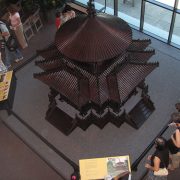
The Ten Thousand Springs Pavilion at the Irving Arts Center

The Ten Thousand Springs Pavilion at the Irving Arts Center

 Four days, six Affiliates and five hundred miles.  

We try to make the most of our visits to Smithsonian Affiliates and especially enjoy the vitality and diversity of our partners in the Dallas area.  The catalyst for this trip, July 12 – 15, was the opening of Within The Emperor’s Garden: The Ten Thousand Springs Pavilion at the Irving Arts Center.  Director Richard Huff and his staff did a magnificent job of situating this intricate and massive structure and accompanying text and graphic panels in the Center’s main lobby.

The Smithsonian’s Museum Conservation Institute organized the exhibition;  conservator Don Williams and his team of volunteers assembled the 3,000 pieces – a show all by itself.  Opening day featured family-friendly activities ranging from Chinese calligraphy to Tai Chi.  Paula Wallace, President of the Savannah College of Art and Design greeted guests, as did Tsai Lien, General Counsel in Houston of the People’s Republic of China, and other officials from the city of Irving.  The exhibition stays on display until July 2010.  If you’re in Texas, stop off and see it.

And if you have a few more days, check out the other Affiliates on my route: The Women’s Museum: An Institute for the Future; the Museum of Nature and Science; the African American Museum; Frontiers of Flight Museum; and a little further away but well worth it, the Star of the Republic Museum in Washington, birthplace of Texas independence.

Thanks to Affiliates in Dallas, visitors can see our national collections – from space capsules to sports history – upfront and expertly displayed.  The lone star shines very bright on Smithsonian Affiliates deep in the heart of Texas.

Who will be chosen? The decision is yours.

Rendering for the future Only in America gallery.

Rendering for the future Only in America gallery.


Thanks to Ilana Blumenthal, Public Relations Associate at the National Museum of American Jewish History, for this guest post.


My first vote is going to the Marx Brothers. That’s an easy one. Their quick wits and dry humor have filled both my childhood and adulthood with laughter, and to me, humor is one of the greatest contributions one can make to society. I can’t forget Richard Rodgers or Stephen Sondheim. At the age of 27, I have found that their music and words have taught me more about the world, history and human nature than textbooks ever could have and with much more color and passion. Additionally, I have lived my life as a committed Zionist, so Golda Meir or Henrietta Szold also make my list of the top 18 American Jews that I feel have made the biggest contribution to society. Who will make yours?


The National Museum of American Jewish History launched a website, https://onlyinamerica.nmajh.org/, that asks the public to help select who will be included in our Only in America® Gallery/Hall of Fame, which will be a signature component of the core exhibition when the new Museum opens in November 2010. Situated on the first floor of the Museum, the gallery will examine the choices, challenges and opportunities that have been faced by a remarkable group of American Jews on their paths to accomplishment through featuring major film productions, original artifacts, and an interactive database.


Visitors to the website will have the opportunity to vote on a list of 218 candidates in the fields of Arts and Entertainment; Business and Philanthropy; Literature; Performance; Politics, Law and Activism; Religion and Thought; Science and Medicine; and Sports. Participants can also cast write-in votes. Voting ends Thursday, August 6, so hurry.


Irving Berlin. Levi Strauss. Steven Spielberg. Albert Einstein. Rebecca Gratz. Sandy Koufax. Molly Picon. Which Jewish Americans should be recognized in a major museum exhibition? The National Museum of American Jewish History is inviting you to tell us what you think. Let us know.


The Museum is constructing the new 100,000–square-foot, five-story building on Independence Mall in Philadelphia. It is dedicated to telling the still-unfolding story of Jews in America, who embraced freedom with its choices and challenges as they shaped and were shaped by our nation. The Museum envisions its new home as a place that welcomes all people, inviting them to discover what they have in common with the Jewish experience in America, as well as to explore the features that make this history distinctive.


Which one will you choose? 

Which one will you choose?


Let’s Eat

Season 2 starts on Monday July 12!

Season 2 starts on Monday July 12

On Monday July 12, Smithsonian Networks launches the second season of its signature series, “Stories from the Vaults” with a look at the incredible, edible Smithsonian.  It features Native cuisines and collections of the Pacific Northwest at the American Indian Museum (think: salmon!), and the origins of the American coffee break in the American History Archives (enter: Krispy Kreme).  The final segment is on the mechanics of eating and the toll food takes on our teeth, featuring our very own Baltimore Affiliate, the National Museum of Dentistry.  Go behind the scenes with the Dentistry Museum’s curator Scott Swank, as he shows off historic extractors and toothbrushes and other items from their collection.

To watch the whole show, click here.  Bring your appetite, and enjoy!

Textile Revolution!

What do sheep and baseballs have in common?

Textile Revolution: An Exploration through Space and Time

Textile Revolution: An Exploration through Space and Time exhibition entrance


WOOL!

WOOL!

This is one of the many intriguing questions answered in the new permanent exhibition, Textile Revolution: An Exploration through Space and Time at the American Textile History Museum in Lowell, Massachusetts.

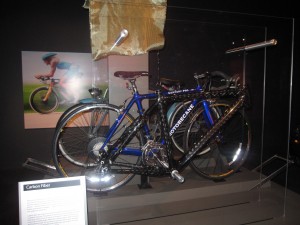
On June 19, the Museum cut the ribbon on their own revolution.  Having been closed for two years, the Museum reopened with updated, interactive displays that tell the history of American textiles, up to the present.  “Most people have no idea how their lives are shaped by textiles – far beyond the clothing they wear,” said Jim Coleman, the Museum’s President and CEO.  Indeed, the exhibition moves the visitor though spinning yarn in the home in pre-industrial times (hence, where we get the term “spinster“) to contemporary textiles that encompass cars, high-performance bicycles, and “sharkskin” suits worn by Olympic swimmers.

Carbon fibers woven into a high-performance bicycle frame.

Carbon fibers woven into high-performance bicycle frames.

Lowell Mayor “Bud” Caulfield called the renovated Museum “a jewel in Lowell’s cultural landscape.”    Through its innovative approach to illuminating the history of textiles and the importance of textiles to the scientific, medical, aeronautic fields and beyond, the Museum is truly a jewel in America’s cultural landscape.  With tens of thousands of textiles spread across at least 6 Smithsonian museums, we can’t wait to get started collaborating with the Museum to enhance the story through our Affiliate partnership.

Kudos to the Museum – its staff, board, donors and supporters – on a job well done!

Museum stakeholders cut the ribbon to the new Museum and permanent exhibition.

Museum stakeholders cut the ribbon to the new Museum and permanent exhibition.


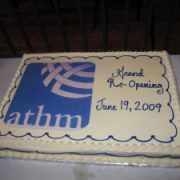
The Museum really knows how to celebrate!

The Museum really knows how to celebrate!