
Coming Up in Affiliateland in March 2020
Spring is in full swing with so many great events nationwide. Happy Women’s History Month!
 TEXAS
TEXAS
The John P. McGovern Museum of Health & Medical Science will feature a daily screening of the Smithsonian Channel film The Rise of the Killer Virus film as part of the Outbreak: Epidemics in a Connected World exhibition from the National Museum of Natural History, in Houston, 3.1-31.2020.
NORTH CAROLINA
The North Carolina Museum of History will screen the Smithsonian Channel film The Green Book: Guide to Freedom in Raleigh, 3.12.
National Museum of American History curator Barbara Clark Smith will give a talk on Reflections on American Democracy – in a Time of Political Uncertainty at the Greensboro History Museum, 3.18.
NEW MEXICO
The Hubbard Museum of the American West will screen the Smithsonian Channel film AERIAL AMERICA – The Wild West in Ruisdoso Downs, 3.14.
NATIONWIDE 
Twelve Affiliates will host Earth Optimism Teen Events in collaboration with the National Museum of Natural History on March 14. Participating Affiliates include the Anchorage Museum (Anchorage, AK); Buffalo Bill Center of the West (Cody, WY); Cape Fear Museum (Wilmington, NC); Frost Science Museum (Miami, FL); High Desert Museum (Bend, OR); Lowell National Historical Park (Lowell, MA); Mid-America Science Museum (Hot Springs, AR); New Mexico Museum of Natural History and Science (Albuquerque, NM); Pinhead Institute (Telluride, CO); Science Museum Oklahoma (Oklahoma City, OK); U.S. Space and Rocket Center (Huntsville, AL); Western Science Center (Hemet, CA).
RHODE ISLAND
The Rhode Island Historical Society in partnership with the Community College of Rhode Island will host Dr. Ariana Curtis, curator at the National Museum of African American History and Culture, to give a lecture on Deliberate and Afraid of Nothing: Diversifying Women’s Representation, in Providence, 3.19.
ARIZONA
The Desert Caballeros Western Museum will host Art and Advertising in Buffalo Bill’s Wild West, a public lecture by Smithsonian scholar Dr. Michelle Delaney, in Wickenburg, 3.21.

Famous Pittsburgher Andy Warhol, one of the portraits soon to be on view at the Heinz History Center. By Hans Namuth, 1981. National Portrait Gallery, Smithsonian Institution: this acquisition was made possible by a generous contribution from the James Smithson Society
PENNSYLVANIA
The Heinz History Center will open Smithsonian’s Portraits of Pittsburgh: Works from the National Portrait Gallery, an exhibition of nearly 60 works of art on loan from the Smithsonian, in Pittsburgh, 3.21.
NEW YORK
Dr. Dwan Reece, curator at the National Museum of African American History and Culture, will speak on What it Means to be Free: The Woman’s Revolution in American Entertainment as part of the Rockwell Museum’s Advancing Women lecture series, in Corning, 3.17.
Snug Harbor Cultural Center and Botanical Garden will screen the Smithsonian Channel film Blondie’s New York in Staten Island, 3.28.
Jennifer Brundage, National Outreach Manager will join the director and staff of the Rockwell Museum in the Silo Breakdown: Internal Collaboration and Activating A Smithsonian Affiliation session at the Museum Association of New York conference in Albany, 3.29-31.



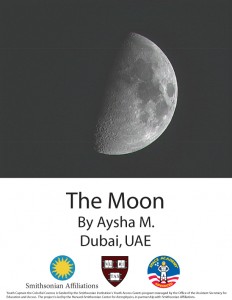 At the U.S. Space and Rocket Center® and Space Camp, we are constantly looking for fun and innovative ways to teach our museum guests and trainees about space history and the science and math concepts that surround it. Naturally, we were excited to participate in the Harvard-Smithsonian Center for Astrophysics series of instructional webinars in order to get some fresh ideas and content. The creativity started to flow as we reviewed the background material, but the amount and quality of the lesson plans and information presented to us by Mary Dussault and Erin Braswell was impressive. By the end of the first hour of the webinar, we had solid ideas and lesson plans that could be implemented in every program from summer Day Camp for 5-year-olds to Advanced Space Academy® for high-school seniors. And they meet both state and national curriculum guidelines! In this case, our target subject was astronomy.
 For our Advanced Academy (junior high to high school) trainees, we added an image processing component into our existing astronomy curriculum which is made up of four components. At the beginning of the week, the trainees participate in a lecture called “Exploring the Night Sky” where they learn the basics of astronomy and focus on finding and naming the constellations and deep space objects. Our second astronomy block is the “Micro Observatory Lab,” where our trainees use the Mobs software to compile full-color images of deep space objects. Our third astronomy block is a “Night Telescope” activity, where the trainees use real telescopes to find the same objects in the sky of which they compiled images the day before. And for our final astronomy block, our Advanced Academy trainees learn the stories behind selected constellations in our inflatable Star Lab.
 We have been running the “Micro Observatory Lab” astronomy block since December, 2011, and have had more than 1,500 trainees from all over the world participate. We have so many students participating that we aren’t able to display all their artwork at once, so we have set up two small rotating exhibits of 12 featured photos each here at the U.S. Space and Rocket Center, one located in the Main Museum and the other located in the Science Lab used for our summer Space Academy for Educators® camp, and we plan to add a third, larger display to our computer lab this summer.
 The Smithsonian’s Lemelson Center for the Study of Invention and Innovation has met this opportunity head on by launching the Spark!Lab Outreach Kit Project, through a distribution of six organizations including five Affiliate museums. This collaboration is seen as an effort to extend the reach of Spark!Lab–the center’s hands-on invention activity center–beyond the boundaries of the National Museum of American History. The kits will be designed to replicate some of the most popular Spark!Lab activities and provide opportunities for partner museums to connect their collections and exhibitions to themes of invention and innovation.