
Tag Archive for: access smithsonian

2024, An Affiliate Recap

It was an exciting year for collaboration and inspiration in so many communities! With the help of our Smithsonian Affiliates (find the Affiliate directory here), we brought the Smithsonian to communities across the country for an incredible year of collaboration, learning, and inspiration. Our Smithsonian Affiliates help connect Smithsonian initiatives with their local communities to help address many of the challenges we face. Our Affiliates are doing important and necessary work every day, and collaborating with the Smithsonian amplifies this incredible work. Here are a few highlights of Smithsonian-Affiliate engagements from 2024.


2024, An Affiliate Recap by Smithsonian Affiliations


A group of people take a selfie in front of a red brick building
High school Learning Center students and coordinator, Rockwell Museum educator and Smithsonian educators. The Rockwell Museum, Corning, NY.

National Youth Summits and the Youth Leadership Team

Since 2011, the National Museum of American History has collaborated with Smithsonian Affiliates to engage teens nationwide in the National Youth Summit program. Affiliate organizations serve as Regional Summits using content from the American History Museum and their own resources to engage local middle and high school students in discussions grounded in history and connected to current issues. In September 2024, a group of nine diverse Smithsonian Affiliates participated in the 2024 Summit exploring Elections & Politics.

Four Affiliates—Arab American National Museum (Dearborn, MI), The Rockwell Museum (Corning, NY), International Museum of Art and Science (McAllen, TX), and Japanese American National Museum (Los Angeles, CA)—were part of a pilot Youth Leadership Team. This project, funded by a Smithsonian Together We Thrive grant, aimed to enhance teen advocacy and agency in the Summits. The goal was to center youth voices in the planning and development of Summit programming. Twelve teenagers were recruited to discuss democracy, social justice and national issues faced by teens today. Throughout the planning, students met with Smithsonian and Affiliate staff virtually and traveled to Washington, D.C., in August to meet with Smithsonian experts and fellow team members.

Since 2011, the National Museum of American History has collaborated with Smithsonian Affiliates to engage teens nationwide in the National Youth Summit program. Affiliate organizations serve as Regional Summits using content from the American History Museum and their own resources to engage local middle and high school students in discussions grounded in history and connected to current issues. In September 2024, a group of nine diverse Smithsonian Affiliates participated in the 2024 Summit exploring Elections & Politics.


African American Craft Initiative

Courtesy City Lore

Three Affiliates —City Lore (New York, NY), Michigan State University Museum (East Lansing, MI), and Orange County Regional History Museum (Orlando, FL)—were selected to participate in the African American Craft Initiative. The project from the Center for Folklife and Cultural Heritage aims to expand the visibility of underrepresented elder African American artisans and safeguard their stories. The project is meant to build relationships among artists, elders, and youth within their local communities.


The Affiliate Learning Hub
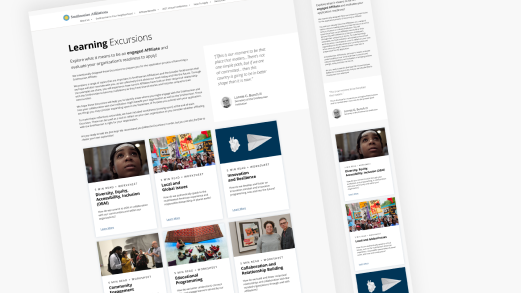
A screen grab of the Learning Excursions page

In 2024 we launched the Learning Hub, which includes individual Learning Excursions that help Affiliate leadership and their teams think about their work today and into the future. These Excursions inspire Affiliates to continually think about ways they can work together and with the Smithsonian.

Affiliate staff can take a deeper dive into these Excursions:

  • Essentials: For new and existing Affiliates to take a deeper dive into community engagement, collaboration and relationship building, and more
  • Affiliate Stories: Modules to enhance your collaborative efforts, build leadership skills, and showcase your impact.
  • Tools for Action: Download reflection guides and toolkits to facilitate ongoing learning and skill development.

See Me at the Smithsonian Professional Development Training

four people participate in a workshop at an art museum
Courtesy Access Smithsonian

In 2024, Access Smithsonian offered a hybrid professional development training series for the creation and implementation of programming for adults living with dementia and their care partners. Twenty-eight Smithsonian Affiliates were selected to participate. The training presented Affiliate staff with tools and strategies for adapting the See Me at the Smithsonian model at their organizations.

See Me at the Smithsonian has made it possible for people with dementia and their care partners to continue to enjoy Smithsonian museums, engage with the Smithsonian’s most beloved objects, sustain lifelong learning, and connect with and contribute to a larger community.


Participants of the 2024 Affiliate Directors’ Summit. Courtesy Jeremy Norwood for Smithsonian Affiliations

Affiliate Directors’ Summit

In November, the Smithsonian Affiliations team hosted its first in-person gathering for Affiliates since 2019. The Affiliate Directors’ Summit brought together 41 Affiliate leaders in Washington, D.C., to network with and learn from each other and Smithsonian leadership. Participants identified actionable strategies for new or enhanced collaborations that extend and deepen our collective impact. Prior to the in-person gathering, Affiliate leadership joined a special virtual meeting with Smithsonian Secretary Lonnie G Bunch III.

In all, Affiliates were involved in more than 800 engagements with the Smithsonian during 2024. Thank you to the entire Smithsonian Affiliations team for your continued excellence in facilitating Affiliate-Smithsonian relationships and guiding so many collaborations from idea to implementation. We wish our Affiliate and Smithsonian colleagues a wonderful holiday season and look forward to 2025 collaborations!

Thinking about how you can collaborate in 2025? Contact your National Outreach Manager or email Affiliates@si.edu and let’s brainstorm!
All Here: Accessibility and Diversity:Balancing Design, Content and Access in the Molina Family Latino Gallery

Many thanks to Eli Boldt, 2023 Smithsonian Leadership for Change intern, for this guest post. Boldt was one of several interns identifying and writing stories about underrepresented topics for Smithsonian Affiliations. This is one of two stories they completed this summer. 

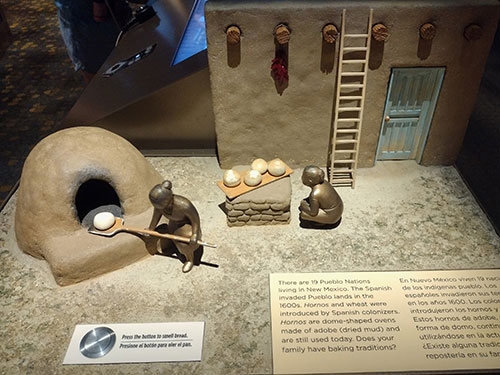
A small, tactile display showing a scene from the Pueblo lands. One bronze, woman figurine is placing bread into a round, clay oven. Another is watching loaves of bread cool. To the bottom left is a button that prompts a user to push to smell bread.
One of the tactile displays in the exhibition which, when the silver button is pressed, releases an odor of bread baking. Photo by Eli Boldt.

The Molina Family Latino Gallery, which opened in June 2022, is a precursor to the National Museum of the American Latino. The museum, legislated by Congress in 2020, is still in development and currently has exhibition space at the Smithsonian’s National Museum of American History. The Molina Gallery is a taste of what the museum will be: it represents the many varied histories of the Latino experience in America and the way Latino culture and figures have impacted and shaped the United States.

The exhibition was developed using a design model called I.P.O.P., a framework for building a content strategy focusing on Ideas, People, Objects, and Physical experiences. This allows the content to be diversified across the exhibition. Some people connect more with objects, while others connect with pictures and stories of people. Some people benefit heavily from having physical experiences, which tactile objects help to do.

Making an exhibit accessible is a balancing of the many types of people who are coming into the space. To design with accessibility in mind means finding the sweet spot where information is available and accessible to the most amount of people.

Under the direction of Elizabeth Ziebarth, Access Smithsonian helped bring the gallery’s vision for inclusive design to fruition. Leading a small but mighty team—Ziebarth is both director of Access Smithsonian and head diversity officer at the Smithsonian—the staff strives “for consistent and integrated inclusive design that provides meaningful access” in all their work. Ziebarth identifies making a space accessible to the blind as the most challenging.

“My rule of thumb is that if I can make something accessible to people who are blind or have low vision, I could probably make everything else accessible. The most challenging part of the design is to take something that is visual and make it into something that can deliver the content and the experience to somebody who can’t see it,” Ziebarth said.

A black and white QR code that can be scanned for visual descriptions.
One of the QR codes that can be scanned for visual descriptions. Photo by Eli Boldt.

Ways the gallery took on the challenge was creating a shoreline, a perimeter of cases around the middle. People who use canes can tap their way through and follow the path. There are cues and raised tabs on the ground to identify where QR codes, which pull up audio narration, are located. The gallery makes use of tactiles to tell the story as well. Tactiles are objects that are meant to be touched and interacted with. The museum shows a clay figurine and invites visitors to touch. There is a button that releases the smell of bread, another that plays the sounds of Domino Park, Miami, and releases the smell of coffee. There are audio descriptions and closed captions on video content for deaf and hard-of-hearing visitors, and space for wheelchair users to have as much mobility as possible.

The accessibility of the gallery is not unique, but it also is not the standard. It was made possible because accessibility was a part of the conversation from the start. Access Smithsonian was able to make a substantial impact on the exhibit’s layout, design, and technology because the designers and curators asked questions about accessibility all throughout.

“There’s no way that we can be everywhere, and we rely on developing relationships, trust, and a great understanding with teams,” said Ashley Grady, senior program specialist at Access Smithsonian. “They hopefully have the knowledge to make a lot of decisions independently, but they know that we’re always here for that guidance and access to user/expert testing or the disability community.”

The gallery was designed by Museum Environments, an organization that designs and creates multicultural and sustainable exhibits. Mariano Desmarás, the creative director for Museum Environments, was eager to help make the gallery accessible. He noted that as a consultant and designer, he can make suggestions but to do what the gallery ended up accomplishing, the backing of the institution and its leaders is essential. Desmarás points to his own background of having undiagnosed ADHD as a child and his experience with dyslexia, as well as his father’s later-in-life vision impairment, as reasons why accessibility is so important to him.

“Everybody had some sort of connection that they could make to why it would be important to have an inclusively designed exhibition space. And so that made a difference,” Ziebarth said.

That lived experience of seeing the struggles of people with disabilities is often a motivator for making spaces accessible; it is why user/expert testing was vital to the creation of the gallery and its accessible features.

The Institute for Human Centered Design (IHCD) is a non-profit organization doing work with inclusive design. Their user/experts are people who, through their own lived experiences, have expertise. IHCD and Access Smithsonian brought user/experts into the gallery as it was being built.

A clay tactile figure of a boy, worn down by touching.
Another tactile element which has been worn down by visitors touching it. Photo by Eli Boldt.

A typical user/expert testing session, as described by Grady, would begin with her meeting the exhibit team to understand what questions needed to be answered in that specific session. This ensured the right people were there to help. If they needed to test assistive listening devices, people who were Deaf or hard of hearing were prioritized.

“While those things can be intersectional, it’s important to make sure we’ve got the right people that would benefit the most from whatever the equipment is or element is,” Grady said.

The sessions were conversational. They engaged more with contextual inquiry to see how people engaged with the content. The sessions often included Access Smithsonian as well as people working on the exhibit’s content and design. This allowed for questions to be asked and answered as real people experienced the content.

The sessions lasted anywhere from 90 minutes to 2 hours, Grady explained, but they could look different depending on what was being tested and how many people were brought in. Sometimes only one or two components were being tested, whereas other times the sessions would be a comprehensive walkthrough of the gallery. Of course, user/expert testing was halted during the pandemic, but the team pivoted the testing to Zoom and continued their work.

A tactile display representing Domino Park in Little Havana, Miami. A game of dominos set up in the middle, with a coffee pot that emits the smell of coffee to the bottom left. In the back, between two small pillars is a photo from Domino Park.
A tactile display representing Domino Park in Little Havana, Miami. Photo by Eli Boldt.

Through user testing, things changed. Many were small changes, of course, but even small changes helped make every component as accessible as it could be. Color contrasts were changed, the heights of QR codes adjusted and font size perfected. When they got into the space, the design team mapped out the floorplan with blue tape according to ADA standards only to realize that the turn radius was not enough for motorized wheelchairs.

Michelle Cook, an inclusive design specialist with Access Smithsonian, stressed that the minimum standards are just that: the minimum.

“That’s one of the things that has been historically a challenge for those of us in the design field — and advocates for accessible or inclusive design — has been convincing people that it’s better to do more than the minimum because it serves a more diverse audience,” Cook said.

And diversity is what the Molina Family Latino Gallery is trying to communicate. To show that populations you might not think about are vital to the history of the United States. Latino history is American history: our cultures are intertwined. And within that diversity is the intersection of accessibility. They are two ideas that exist within each other.

“There’s this fear that inclusion focuses on a particular population and that it’s reductive,” Desmarás said. “I actually think that if it’s done right, inclusion is additive. That you’re saying that we’re all here.”


Source list:

  • https://latino.si.edu/
    The website for the National Museum of the American Latino, a project currently in production. At the end of 2020, Former President Trump signed a bill for its creation. What was formerly the Smithsonian Latino Center became the National Museum of the American Latino.
  • https://latino.si.edu/support/molina-family-latino-gallery
    The website for the Molina Family Latino Gallery. The gallery is the precursor to the National Museum of the American Latino.
  • https://americanhistory.si.edu/
    The website for the National Museum of American History, where the Molina Family Latino Gallery lives.
  • https://latino.si.edu/lead-donors-molina-family
    The five children of Dr. C. David Molina collectively donated $10 million for the creation of the gallery.
  • https://access.si.edu/
    The website for Access Smithsonian. This organization was created in 1991 and works with museums to create meaningful access for everyone.
  • https://museumenvironments.com/
    Museum Environments is an organization that creates exhibits on large and small scales. They specialize in multicultural and bilingual exhibitions. For ¡Presente! they won the 2023 Smithsonian Award for Excellence in Exhibitions.
  • https://www.humancentereddesign.org/
    The Institute for Human Centered Design is an education and design non-profit organization focused on universal, inclusive and accessible design. They were a part of creating the Molina Family Gallery, including but not limited to user/expert sessions.
  • https://www.humancentereddesign.org/user-expert-lab
    User/experts have personal experience with disabilities or limitations and can provide expertise and advice for design. They were heavily involved in the creation of the Molina Family Latino Gallery.
  • https://www.ada.gov/law-and-regs/design-standards/
    The website for the Americans with Disabilities Act and the design standards. As noted by Smithsonian employees through the experience of creating an accessible exhibition, ADA standards do not cover newer devices and are often insufficient. Described as the bare minimum. 

“See Me” workshop with Access Smithsonian

Professional Development Opportunity: Developing and Implementing Programming for Adults Living with Dementia and Their Care Partners

four people participate in a workshop at an art museumAccess Smithsonian invites Smithsonian Affiliates to participate in a virtual professional development training workshop on the development and implementation of programming for adults living with dementia and their care partners. The two-day workshop, June 17-18, 2021, 1:00 p.m. to 4:00 p.m. Eastern Time, will present attendees with tools and strategies on how to adapt the See Me model at their organizations. Led by Access Smithsonian staff and contractors, topics will include: our approach, active listening & close looking, program content development, shifting from on-site to virtual learning, meeting the needs of our participants, and a program demonstration.

Created by Access Smithsonian, See Me at the Smithsonian has made it possible for people with dementia and their care partners to continue to enjoy Smithsonian museums, engage with the Smithsonian’s most beloved objects, sustain lifelong learning, and connect with and contribute to a larger community. Since our pilot in 2017, See Me now includes seven participating Smithsonian museums, relationships with community-based care facilities, See Me en Español, and a virtual model for delivering See Me to individuals in their homes and larger groups residing in assisted living facilities and memory care units. Most importantly, Access Smithsonian has remained connected to its audiences throughout the COVID-19 pandemic providing opportunities for intellectual engagement, socialization, and stress reduction.

A workshop instructor stands in front of a seated group and points to a large black and white painting

The number of Americans living with Alzheimer’s is growing. One in nine Americans age 65 and older is living with Alzheimer’s dementia, and it is anticipated this population will more than double by 2050. Over the past year, the COVID-19 pandemic has further laid bare the vulnerabilities of adults living with Alzheimer’s dementia. Museum-based programs like See Me offer positive emotional and cognitive experiences, enhance verbal and non-verbal communication, reduce isolation and depression, and build social networks – for both individuals with dementia and their care partners.

Live captioning will be provided for the workshop. Other access services (e.g., ASL, audio description, etc.) are available upon request. *Registration has closed.

A person in a red tshirt seated at a green table paints For more information about the program, please contact Ashley Grady, Senior Program Manager, Access Smithsonian, at GradyA@si.edu.

All photos courtesy of Access Smithsonian.