A unique experience: a peek into a two-week visiting professional residency at the smithsonian
Special thanks for this guest post to Jessica Crossman, Experiential Learning Department Program Coordinator at the San Diego Museum of Man, a Smithsonian Affiliate in San Diego, California. Jessica spent two weeks in April 2013 at the Smithsonian.
This year I had the honor of being selected to participate in the Smithsonian Affiliations Visiting Professionals Program. My goal while in Washington, D.C., was to learn about how best to create hands-on/interactive exhibits that effectively integrated educational material and to study the use of technology in these types of exhibits. The museum where I work, the San Diego Museum of Man, is redoing the hands-on part of our Ancient Egypt exhibit. Because of this, those of us working on the exhibit wanted to explore different ways we could approach the idea of interactivity in an exhibit. I spent time at the National Museum of Natural History (NMNH), the National Museum of the American Indian (NMAI), the National Zoo, and the Smithsonian Latino Center. At each of these places I learned how these Smithsonian institutions approached hands-on/interactive exhibits in their own unique way.

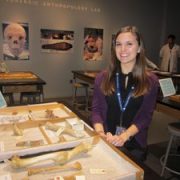
In the Forensic Anthropology Lab at the National Museum of Natural History.
My first week in DC was hosted by NMNH. The members of the exhibits department were kind enough to meet with me, let me attend some of their meetings, and brain storm ideas with me about our exhibit at the Museum of Man. Coming from the Education Department at my own institution, I gained a whole new perspective on what it takes to make an exhibit while learning great logistical ideas and questions to bring back to the Museum of Man, such as how to think about being able to make our exhibit easily adaptable for future changes and how to think about our goals regarding exhibit interactivity. Members of the education department met with me to talk about our education programs and gave me tours of their education spaces in the museum including the Discovery Room, the Q?rius Lab, and the Forensic Anthropology Lab. It was wonderful to see the exhibits from their educational point of view and to hear what their education goals were in the creation of these spaces. One of the most important ideas that I got out this week was the idea of putting the visitor in the role of the “scientist” both in the wording of text panels and in the execution of interactive elements, such as providing tools (microscopes, magnifying glasses, etc.) for the children to use to make scientific observations in the Discovery Room. This approach helped the team at the Museum of Man reform how we wanted to approach our own exhibit.
My second week I spent most of time at NMAI, with some time spent at the Zoo and the Latino Center. At NMAI both the exhibits team and the education team gave me tours of their highly hands-on exhibit for kids called imagiNATIONS, which is designed to show children the innovations and inventions that different Native American Nations have created in order to meet their own specific needs. While learning about this space I was told that people stay and learn when they feel safe and smart. This is something that was taken into account when the NMAI team created this space. While this idea was a simple one it was one of the most important of my trip because once I shared it with the Museum of Man exhibits team it helped us rethink how we wanted to physically design our space so that our visitors would have more of a sense of comfort and would stay longer to learn.

At ImagiNATIONS education space in the National Museum of the American Indian.
My time at the Zoo was focused in learning about their exhibit development process and in getting a tour of their new elephant exhibit. It was wonderful to see an approach to technology as a means of visitor participation in their exhibit in the form of a photo booth. It was fun, effective, and even left visitors with a message of conservation on the photo strips that took home with them. This low tech use of technology was in contrast with the use of technology that I saw at the Latino Center. While at the Latino Center I was given demonstrations of immersive gaming experiences that put students at the site of an archaeology dig, of Augmented Reality at use in exhibits, and of the Latino Center’s digital collections. It was truly amazing to see what possibilities high tech, digital interactives might hold for our visitors.
Along with all of these wonderful learning experiences I met some truly talent and kind people that I hope to keep in touch with. And of course this trip provided the Museum of Man some new ideas for our hands-on exhibit space. There was even talk about possible future collaborations between the education department at NMNH and the Museum of Man as well as the Latino Center and the Museum of Man. I’m very grateful to have been given the opportunity to grow both professionally and personally through this wonderful opportunity.
 At the U.S. Space and Rocket Center® and Space Camp, we are constantly looking for fun and innovative ways to teach our museum guests and trainees about space history and the science and math concepts that surround it. Naturally, we were excited to participate in the Harvard-Smithsonian Center for Astrophysics series of instructional webinars in order to get some fresh ideas and content. The creativity started to flow as we reviewed the background material, but the amount and quality of the lesson plans and information presented to us by Mary Dussault and Erin Braswell was impressive. By the end of the first hour of the webinar, we had solid ideas and lesson plans that could be implemented in every program from summer Day Camp for 5-year-olds to Advanced Space Academy® for high-school seniors. And they meet both state and national curriculum guidelines! In this case, our target subject was astronomy.
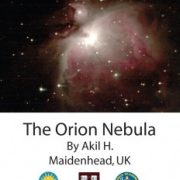
 For our Advanced Academy (junior high to high school) trainees, we added an image processing component into our existing astronomy curriculum which is made up of four components. At the beginning of the week, the trainees participate in a lecture called “Exploring the Night Sky” where they learn the basics of astronomy and focus on finding and naming the constellations and deep space objects. Our second astronomy block is the “Micro Observatory Lab,” where our trainees use the Mobs software to compile full-color images of deep space objects. Our third astronomy block is a “Night Telescope” activity, where the trainees use real telescopes to find the same objects in the sky of which they compiled images the day before. And for our final astronomy block, our Advanced Academy trainees learn the stories behind selected constellations in our inflatable Star Lab.
 We have been running the “Micro Observatory Lab” astronomy block since December, 2011, and have had more than 1,500 trainees from all over the world participate. We have so many students participating that we aren’t able to display all their artwork at once, so we have set up two small rotating exhibits of 12 featured photos each here at the U.S. Space and Rocket Center, one located in the Main Museum and the other located in the Science Lab used for our summer Space Academy for Educators® camp, and we plan to add a third, larger display to our computer lab this summer.